Warehouse and industrial demolition in the province of Málaga
Steel halls, block warehouses and factory buildings demolished by machine, with plant dismantling, sorted waste and delivery receipts.
Industrial demolition · Málaga
Industrial demolition for developers, investors and owners in the province of Málaga: warehouses, factory buildings, reinforced concrete, slabs and foundations brought down by machine, with the rubble sorted and taken away.

In short
Derribos Industriales Málaga is a demolition contractor that knocks down warehouses and industrial buildings, breaks out concrete slabs and foundations and removes the rubble anywhere in the province of Málaga. Work is done by machine, by hand or combined, following your técnico's documentation, with waste sorted on site and delivery receipts from an authorised facility. You can deal with us in English.
Six services that usually come together on an industrial site: the building, the concrete, what lies under the ground, the machines that do it, and what happens to the rubble afterwards.
Steel halls, block warehouses and factory buildings demolished by machine, with plant dismantling, sorted waste and delivery receipts.
Floor slabs, hardstanding, patios, driveways and foundations broken out by machine, with steel separated and rubble removed.
Reinforced and mass concrete demolished with breakers, crushers and shears; steel separated, concrete crushed or removed.
Concrete and masonry rubble crushed on site where it suits the project; all fractions sorted and sent to authorised facilities.
Demolition rubble loaded by fraction into skips, bags or lorries and taken to authorised facilities, with delivery receipts.
Excavators with crushers, shears and breakers; top-down and high-reach demolition, selective dismantling and CDW removal.
An industrial demolition contractor takes a commercial or industrial structure down to the level the client needs, separates the materials and leaves the site ready for the next phase. In the province of Málaga that typically means steel-framed warehouses on business parks, concrete-block workshops, older multi-storey factory buildings, agricultural sheds, loading bays and the slabs and foundations they stand on.
Derribos Industriales Málaga covers the whole sequence: warehouse and industrial demolition, machine demolition with excavators and hydraulic attachments, breaking out reinforced concrete, removing floor slabs and foundations, loading the rubble and arranging its transport to an authorised facility. What we do not do is draft projects, sign technical reports or apply for permits: those belong to your técnico and to you as the owner or developer. We work from that documentation and coordinate dates with the people who wrote it.
The distinction matters when you compare offers. A demolition quote that also promises the licence, the project and the safety study is either bundling the work of other professionals or skipping it. Ours is limited to execution, which keeps responsibilities clear and lets your architect or engineer stay in charge of the technical side.
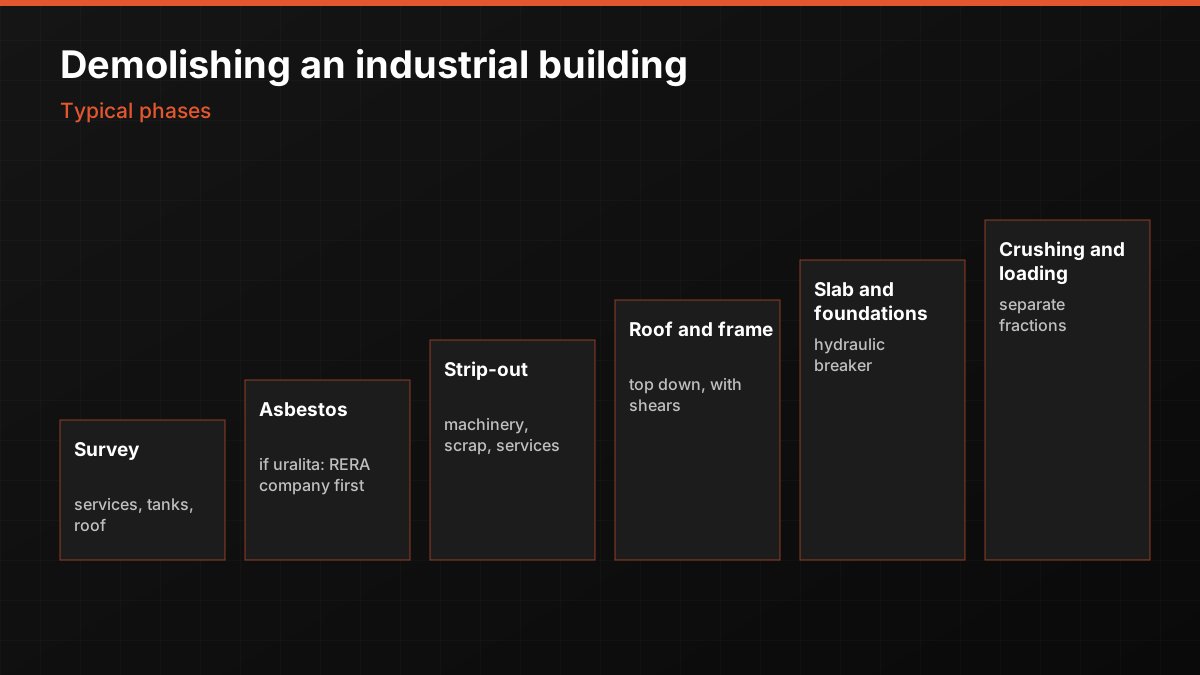
A warehouse is demolished in a fixed order: services disconnected, hazardous materials identified and removed, the building stripped of reusable and separable materials, the structure brought down by machine, and finally the slab and foundations broken out if the brief requires it. Skipping or reordering those phases is what causes contaminated rubble, damaged neighbouring units and stalled sites.
On a typical steel portal-frame building the cladding and roof sheets come off first, then the purlins and frames are cut and lowered in a controlled sequence so that nothing falls outside the work zone. Concrete-block and brick industrial buildings are taken down with shears or a demolition grab, working from the top of the walls downwards. Older multi-storey factory buildings are demolished floor by floor from the top, often with a long-reach machine, which is what the photo of the four-storey building on this page shows.
The guide to warehouse demolition phases and planning goes through each stage, the documents that sit behind it and the decisions you, as client, need to make before the first machine arrives.
On industrial sites the part you cannot see frequently takes more time than the building itself: thick floor slabs, reinforced ground beams, pad foundations, pits, ramps and service trenches. Whether all of that has to come out depends on what the site will become, and that decision belongs in the project, not on the day of demolition.
A new development with basements usually needs everything removed. A plot sold as a clean solar may only need the slab broken and the foundations left where the buyer's project allows it. A yard being reused for storage might keep its hardstanding entirely. Our pages on concrete demolition and on slabs and foundations explain how each element is broken out, and the reinforced concrete techniques guide compares hydraulic breakers, crushers and shears on heavily reinforced sections.
Reinforced concrete is not simply harder rock. The steel has to be separated from the concrete so that each goes to the right destination, which is why a crusher jaw that cuts and frees rebar often produces cleaner material than a breaker alone.
Most industrial demolition is mechanical, because the scale and weight of the elements make hand work slow and dangerous. Hand demolition still has a role where a machine cannot reach or where the building being demolished touches one that stays: a party wall with a neighbouring unit, an office block attached to a hall, an interior that has to be stripped before the structure comes down.
The choice of machine and attachment depends on height, structure, access and surroundings. A standard tracked excavator with a grab sorts and loads; a hydraulic breaker deals with mass concrete; a crusher or pulveriser handles reinforced elements; shears cut steel sections; and a long-reach or high-reach configuration brings down tall structures from the top without people working at height. The guide to excavators, shears, breakers and high reach explains each tool in plain terms.
When a job needs careful hand work, for instance an interior to be emptied inside a building that stays, our sister site Demolición Interior Málaga explains hand demolition in detail.
Under Spain's waste law, Ley 7/2022, demolition waste has to be sorted rather than dumped as a single mixed load. Since 1 July 2022 non-hazardous construction and demolition waste must be separated at least into wood, mineral fractions, metals, glass, plastic and gypsum, and since 1 January 2024 selective demolition is mandatory. Hazardous materials such as asbestos may never be mixed with anything else.
On our sites that means separate piles for concrete, brick and ceramics, steel, timber and the rest, loaded by fraction and delivered to an authorised waste facility. You receive the delivery receipts for each load, which is the evidence your técnico and the town hall look for when the job closes. The rubble removal and skips page covers loading and transport; the guide to waste rules and who is responsible explains the roles of producer and holder.
| Fraction | EWC/LER code |
|---|---|
| Concrete | 17 01 01 |
| Bricks | 17 01 02 |
| Mixtures of concrete, bricks, tiles and ceramics | 17 01 07 |
| Iron and steel | 17 04 05 |
| Wood | 17 02 01 |
| Construction materials containing asbestos (hazardous) | 17 06 05* |
The full list, with the official wording, is in our guide to EWC/LER codes.
Crushing turns clean concrete and masonry rubble into graded aggregate with a mobile jaw crusher, like the machine shown in our photos. It makes sense when there is a large volume of mineral rubble, enough space to set up and stockpile, and a realistic use for the crushed material.
The deciding question is what happens to the aggregate afterwards. If your project can use it as fill or sub-base, crushing reduces the number of lorries leaving the site and the volume delivered to a facility. If nobody can use it, the crushed material still has to leave, and the benefit shrinks. Whether recycled aggregate may be reused on the site is decided by the project and its técnico, not by the contractor. The crushing and recycling service page and the guide to on-site crushing and recycled aggregates set out the conditions.
Crushing also brings dust and noise of its own, so it is planned with the rest of the site's control measures, which the dust and vibration guide describes.
In Andalusia the total or partial demolition of a building is generally processed through a declaración responsable filed with the ayuntamiento, following the 2024 simplification decree (Decreto-ley 3/2024), provided the building is not protected or within a protected setting. Protected buildings, protected settings and archaeological zones still need a licencia urbanística. Each town hall specifies the documents in its own ordinance, so your técnico confirms what applies to your municipality.
The technical documentation, a proyecto or memoria técnica together with the safety and waste studies, is drafted and signed by a técnico competente. Under Real Decreto 1627/1997 every demolition has a health and safety study or basic study, and the contractor prepares its own health and safety plan from it. Under Real Decreto 105/2008 the project contains a waste management study, and the contractor prepares the waste management plan for the site. Those two plans are part of our work.
The town hall may also require a deposit or guarantee for construction waste, returned once delivery to an authorised facility is proven; the amount depends on the local ordinance. Our guide to waste deposits in Andalusia explains when it applies, and Demoliciones Málaga has a fuller guide to demolition permits in Andalusia.
Many warehouses and farm buildings in the province still carry corrugated asbestos cement sheets, known locally as uralita. Those sheets have to come off before any machine touches the structure, and only a company registered in the RERA may remove them, under a work plan approved by the provincial labour authority.
Our business is not RERA-registered. The asbestos removal is carried out by a RERA-registered company working as our subcontractor, which prepares and files the work plan under Real Decreto 847/2026, in force since late October 2026, and removes the material. We coordinate the rest of the demolition around it. The asbestos waste travels separately, is never mixed with other rubble and goes to an authorised manager under code 17 06 05*.
For the asbestos part on its own, our sister site explains asbestos removal in warehouses and industrial buildings, and the blog post on what can go wrong when demolishing a warehouse with an asbestos roof lists the mistakes that stop sites.
A large share of industrial and commercial property on the Costa del Sol and in the Guadalhorce valley is held by investors, funds or families who do not live nearby. For them the practical questions are who is on site, how progress is reported and how decisions get made at a distance.
Demoliciones Málaga describes the remote process from the owner's side on its page on managing a demolition from abroad. The industrial demolition contractor checklist on this site lists the points to settle before you sign with anyone.
The cost of demolishing an industrial building depends on the structure, the materials and the site rather than on floor area alone. We do not publish prices, because two warehouses of the same size can differ widely once the details are known.
The post on what drives the cost of demolishing a warehouse explains each factor. For an orientation figure, the demolition calculator on Presupuesto Demolición gives a rounded band, and its page on industrial demolition cost goes into the pricing logic.
You send photos, location, approximate floor area and what the site should look like at the end; we reply with the questions that affect the method.
We look at structure, access, neighbours and materials, and agree the method and the scope below ground with you and your técnico.
You receive a quote by phases, with the waste fractions and what is excluded, such as asbestos removal or work belonging to other trades.
Your técnico files the paperwork with the ayuntamiento; we prepare our safety and waste plans and fix dates around the asbestos phase if there is one.
Strip-out, structural demolition and, where agreed, slabs and foundations, with materials sorted into fractions as the work goes.
The rubble leaves by fraction, you receive the delivery receipts and the site is handed over at the level agreed.
A long-reach excavator with shears takes down an old four-storey industrial building from the top.

A Hitachi excavator with a demolition crusher works on a multi-storey reinforced concrete structure, with water spray.

Shears take down the walls of a concrete-block industrial building, with water mist to control dust.
Producer, possessor, authorised manager: who carries which duty for demolition rubble in Spain, and which papers prove it was handled correctly.
How to read the six-digit LER/EWC codes for concrete, brick, steel, soil, gypsum and asbestos on demolition delivery receipts.
The Andalusian fianza for demolition waste: legal basis, who lodges it, how the refund works and the paperwork mistakes that delay it.
Frame, roof, contents, slab and waste route: the five things that decide what a warehouse demolition quote looks like.
Volume, space, clean feed and a use for the aggregate: the four conditions that make crushing rubble on site worthwhile.
Mixed fractions, missing receipts, asbestos in the skip and unauthorised skips on the road: waste mistakes and how to avoid them.
Our specialist sites
Yes. We work across the province of Málaga, from the Costa del Sol to the Guadalhorce valley, Antequera, the Axarquía and the Serranía de Ronda.
Yes. Slabs, ground beams and foundations can be included in the same job; how much comes out is agreed beforehand according to what your project needs.
No. The declaración responsable or licence is filed by the owner and their técnico. We work from that documentation and coordinate the dates.
Generally not since 2024: most total or partial demolitions go through a declaración responsable. Protected buildings, protected settings and archaeological zones still need a licencia urbanística.
The contractor prepares its health and safety plan from the study or basic study written by the técnico competente, as Real Decreto 1627/1997 provides. That plan is part of our work.
Yes. Each load goes to an authorised facility and you receive the delivery receipts, which your técnico and the town hall use to close the file.
The asbestos removal is carried out by a RERA-registered company working as our subcontractor, under its own approved work plan. We coordinate the rest of the demolition.
Where there is enough clean mineral rubble, space and a use for the aggregate, crushing on site can be planned. Whether the crushed material can be reused on the site is decided by your project.
Yes. You can write and talk to us in English or Spanish, by e-mail, phone or WhatsApp.
Not necessarily. Many owners rely on their local técnico or representative for site matters, and we can send photo updates at the stages you agree.
No. The cost depends on structure, materials, access and waste. The calculator on our sister site Presupuesto Demolición gives a rounded orientation band.
Photos of the building inside and out, the location, the approximate floor area and height, what the site should look like afterwards and any documents from your técnico.
Yes, with a method that protects the units that stay. Party walls and shared elements are usually taken down by hand or with small machines, then the rest by machine.
Yes, as part of an industrial demolition. Tanks must be emptied and cleaned beforehand, and you need to tell us what they held.
Steel is cut, separated as its own fraction (iron and steel, 17 04 05) and delivered to an authorised facility like the other materials.
Mainly with water spray or mist at the point of demolition, wetting of rubble during loading and a work sequence that keeps debris inside the site.
Yes. Under Ley 7/2022 selective demolition has been mandatory since 1 January 2024, with materials separated into fractions.
If a skip or materials occupy the public road, the town hall's authorisation for occupation of the public road is needed. Check it with the ayuntamiento before work starts.
After a demolition we remove the remains and leave a basic level on the plot. Earthworks for a new project are a separate scope for your groundworks contractor.
No. The quote is given with no obligation. Send the details and we tell you what else we need to price the job.
This form is sent straight to oficina@derribosindustrialesmalaga.eu.
Send photos, the approximate floor area and the location. We reply in English or Spanish with the questions that matter for a quote, with no obligation.