In short
On-site crushing is worth it when a demolition produces a large volume of clean concrete or masonry, the plot has room for the crusher and stockpiles, and the crushed aggregate can be reused on the same site or nearby. On small, cramped or mixed-rubble jobs, loading the rubble and taking it to an authorised facility is normally simpler and cheaper.

Contents
- The short answer: when does crushing on site pay off?
- What on-site crushing actually involves
- Conditions that make crushing worthwhile
- When hauling the rubble away is the better choice
- Comparing the two routes factor by factor
- What about the quality of the recycled aggregate?
- How to decide for your own site
- Frequently asked questions
The short answer: when does crushing on site pay off?
Crushing on site pays off when the saving in transport and in imported fill is larger than the cost of bringing a mobile crusher, setting it up and running it. In practice that balance tips in favour of crushing on bigger industrial demolitions, concrete slab removals and sites where the crushed material will be used again as a base, sub-base or fill under the new project.
It rarely pays off on a single house, a small slab, or any job where the rubble is a mix of brick, plaster, wood and tiles. In those cases the rubble is better loaded and taken to an authorised facility, which recycles it there. Our crushing and recycling service is built around making that decision on numbers, not on habit.
What on-site crushing actually involves
A mobile crusher is a tracked machine with a feed hopper, a jaw or impact crushing chamber and a discharge conveyor. An excavator feeds it with broken concrete or masonry, an overband magnet pulls out the steel reinforcement, and the crushed material comes out as a graded aggregate that is stockpiled on the plot. On our own jobs the photo of a tracked crusher being fed by an excavator shows exactly this set-up.
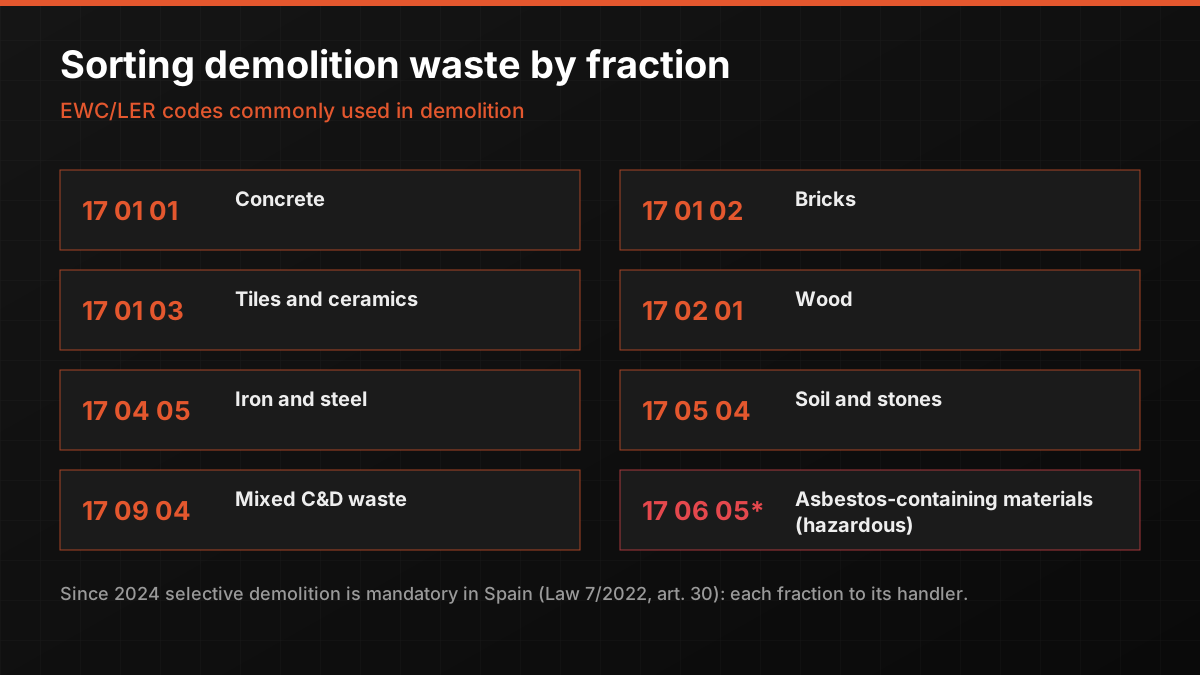
Before the crusher can work, the concrete has to be broken into pieces that fit the feed opening, the rebar has to be reduced so it does not jam the chamber, and contaminants have to be kept out. That is why crushing is the end of a chain that starts with selective demolition. If the building came down as one mixed heap, the crusher would produce a mixed, low-value material. Our guide on on-site crushing and recycled aggregates covers the technical side in more depth.
Conditions that make crushing worthwhile
When most of these conditions are met, crushing on site deserves a serious look:
- Volume. There is a substantial quantity of concrete or clean masonry: industrial floors, ground beams, foundations, concrete frames, retaining walls.
- Space. The plot has room for the crusher, the feeding excavator, an input pile and at least one output stockpile, with safe access for lorries.
- Clean feed. The material can be kept free of plaster, wood, plastic, insulation and soil, which is achievable only with careful sorting during demolition.
- A use for the aggregate. The new project, the técnico and whoever builds next accept the recycled material as fill, base for hardstanding, or sub-base for internal roads.
- Neighbours and hours. The surroundings tolerate the noise and the crusher can work with dust suppression during permitted hours.
Industrial estates and large plots in the Guadalhorce valley or around Antequera often tick these boxes. A villa plot in a dense urbanización on the coast rarely does.
When hauling the rubble away is the better choice
There are clear cases in which crushing makes no sense. Small volumes do not justify the mobilisation. Tight urban plots leave no room to stockpile, and every manoeuvre of the crusher means stopping something else. Mixed rubble from houses, with ceramic tiles, plaster, timber and insulation, produces poor aggregate. Projects that will import a specified material anyway gain nothing from a stockpile they cannot use.
There is also the question of time. If the plot has to be handed over cleared by a fixed date, loading straight onto lorries can be faster than crushing, stockpiling and then deciding what to do with the stockpile. In those cases our rubble removal takes each fraction to an authorised facility, which recycles the mineral fraction itself. The material is recycled either way; the question is only where.
Comparing the two routes factor by factor
The table below sets out the factors that decide between the two routes. It is not a price comparison: every site has its own numbers, which is why the final call is made per job.
| Factor | Crushing on site | Hauling to a facility |
|---|---|---|
| Fixed cost | Transporting and setting up the crusher | None beyond normal loading |
| Variable cost | Crusher running time, feeding excavator | Number of lorry loads and distance |
| Space needed | Large: machine, piles, manoeuvring | Small: loading point and lorry access |
| Material quality needed | Clean concrete or masonry | Fractions sorted by type |
| Result | Aggregate stockpiled on the plot | Cleared plot, delivery receipts |
| Best suited to | Large slabs, concrete frames, industrial plots | Houses, small jobs, mixed rubble, tight sites |
For an idea of how these factors translate into a budget band, the calculator on presupuestodemolicion.eu is the right place; it does not replace a site-specific quote.
What about the quality of the recycled aggregate?
Recycled aggregate is only as good as the material fed into the crusher. Concrete from floors and structural elements, with the steel removed by the magnet, produces a material that is commonly used as fill or as a base layer. Masonry with mortar and ceramic content is weaker and is suited to less demanding uses. Anything with plaster, wood or plastic in it lowers the quality and can make the stockpile unusable.
Whether the aggregate can be used in a specific position of the new project is a decision for the project's técnico, not for the demolition contractor. Our job is to deliver a clean, consistent material and to explain what went into it. Fibre cement that may contain asbestos must never go into a crusher: it is removed beforehand by a RERA-registered company working as our subcontractor and managed as hazardous waste. For concrete-heavy jobs, see also our concrete demolition page.
How to decide for your own site
The decision is easiest when we can look at three things together: an estimate of the concrete and masonry volume, a plan or aerial photo of the plot showing free space, and the intentions for the new project. With those we can tell you whether crushing is a realistic option, what it would leave on the plot and how it compares with hauling.
- Send photos of the structure and the slab, and dimensions or a drawing if you have one.
- Tell us whether a new building, a car park, hardstanding or nothing is planned afterwards.
- Ask your técnico whether recycled aggregate can be used in the new works.
If the main driver is the overall budget of the job, our post on what drives the cost of demolishing a warehouse puts crushing in the context of the other cost factors.
Sources
Frequently asked questions
What is on-site crushing in demolition?
It means processing broken concrete and masonry with a mobile crusher on the demolition site, removing the steel with a magnet and producing a recycled aggregate that stays on the plot.
Is crushing on site always cheaper than hauling rubble away?
No. It only pays off with large volumes of clean material, enough space and a use for the aggregate. On small or mixed jobs hauling is usually the simpler option.
Can house demolition rubble be crushed on site?
It can, but rubble from houses is usually mixed with tiles, plaster and timber, which gives a poor aggregate. In most house demolitions the rubble is taken to an authorised facility instead.
What happens to the steel reinforcement?
An overband magnet on the crusher separates the rebar from the crushed concrete. The steel is sorted as a metal fraction and goes to an authorised facility.
Can I reuse the crushed aggregate in my new building?
Possibly, as fill or base layers, but it is your técnico who decides whether recycled aggregate suits a given part of the new works.
Does crushing on site make a lot of dust?
Crushers generate dust, so the feed and the discharge are kept wet with water spray. Proximity to neighbours is one of the factors we weigh before proposing it.
How much space does a mobile crusher need?
It needs room for the machine, the excavator feeding it, an input pile, one or more output stockpiles and lorry access. A cramped plot usually rules it out.
Can fibre cement or uralita go into the crusher?
Never. Material that may contain asbestos is removed beforehand by a RERA-registered subcontractor and managed separately as hazardous waste.
Is the rubble still recycled if it is not crushed on site?
Yes. Sorted mineral rubble taken to an authorised facility is processed there, so recycling happens in both cases; only the location changes.
Who decides whether crushing is used on my job?
We propose it when the numbers support it, and the final decision is made with you and your técnico based on the project and the site.