In short
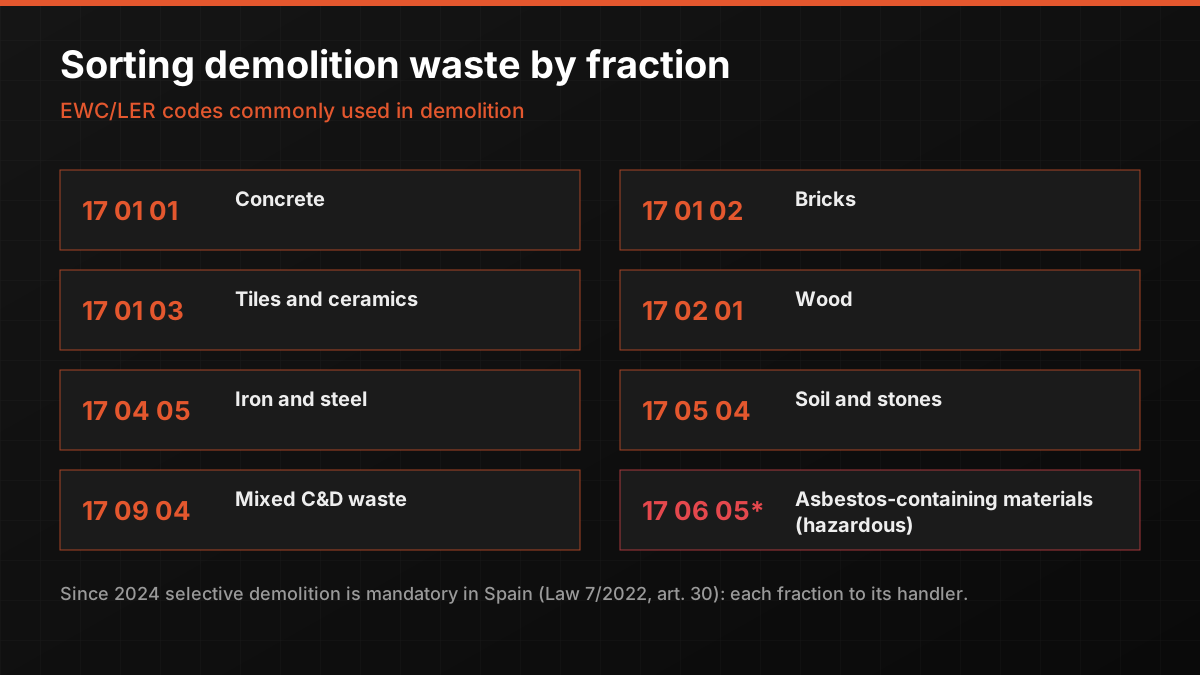
Demolition waste in Spain is classified with codes from the European List of Waste (Decision 2014/955/EU), called LER in Spanish and EWC in English. Typical demolition codes include 17 01 01 concrete, 17 01 02 bricks, 17 04 05 iron and steel and 17 09 04 mixed construction and demolition waste; an asterisk, as in 17 06 05* for asbestos, marks hazardous waste.

Contents
- What is an EWC or LER code?
- How is a six-digit code built?
- Which codes does a typical demolition produce?
- Why sorting decides the code – and the cost
- Concrete with rebar, brick with mortar: the borderline cases
- Asbestos, gypsum and the other fractions that must stay apart
- How to read a delivery receipt
- Where the codes show up in your project
- Frequently asked questions
What is an EWC or LER code?
An EWC or LER code is the six-digit identifier that the European List of Waste assigns to each type of waste. The list was consolidated by Commission Decision 2014/955/EU, and Spain uses it under the name Lista Europea de Residuos – hence LER. English-language documents often call it the European Waste Catalogue, or EWC. Same list, two acronyms.
The code is not decoration on a form. It decides which facility may accept the load, how the facility treats it and how the quantity is reported. When your técnico writes the waste study for a demolition, the estimated fractions are listed by code; when the contractor delivers a load, the receipt carries a code; and at the end of the job the two should tell the same story.
How is a six-digit code built?
The six digits are read in three pairs. The first pair is the chapter, which groups waste by origin; demolition waste sits in chapter 17, construction and demolition wastes. The second pair narrows the family – 17 01 for concrete, bricks, tiles and ceramics, 17 04 for metals, 17 05 for soil and stones, and so on. The last pair is the specific entry.
Two features of the list trip people up:
- The asterisk. An asterisk after the code marks a hazardous waste. In demolition the one you will meet most is 17 06 05*, construction materials containing asbestos.
- Definitions by exclusion. Some entries are defined as everything in a family other than what another code covers. 17 01 07, for example, covers mixtures of concrete, bricks, tiles and ceramics other than those specified in 17 01 06. If there is any suspicion that a fraction is contaminated, the técnico or the receiving manager decides which entry applies – it is not a choice the contractor makes on the lorry ramp.
Which codes does a typical demolition produce?
The codes below are the ones that appear most often when we demolish warehouses, industrial buildings, concrete yards and old houses in the province of Málaga. Official Spanish names follow Decision 2014/955/EU; the English wording is a working translation.
| Code | Spanish official name (short) | English | Where it comes from on site |
|---|---|---|---|
| 17 01 01 | Hormigón | Concrete | Slabs, columns, beams, foundations, precast panels |
| 17 01 02 | Ladrillos | Bricks | Masonry walls, infill panels between frames |
| 17 01 03 | Tejas y materiales cerámicos | Tiles and ceramics | Roof tiles, floor and wall tiles, sanitary ware |
| 17 01 07 | Mezclas de hormigón, ladrillos, tejas y materiales cerámicos (distintas de 17 01 06) | Mixtures of concrete, bricks, tiles and ceramics | Masonry buildings where the mineral fractions cannot reasonably be split |
| 17 02 01 | Madera | Wood | Roof timbers, doors, pallets, formwork |
| 17 02 02 | Vidrio | Glass | Windows, skylights, glazed partitions |
| 17 02 03 | Plástico | Plastic | Pipes, cable ducts, translucent roof sheets, membranes |
| 17 04 05 | Hierro y acero | Iron and steel | Portal frames, purlins, rebar, gates, racking |
| 17 05 04 | Tierra y piedras (distintas de 17 05 03) | Soil and stones | Excavation around foundations, sub-base |
| 17 06 05* | Materiales de construcción que contienen amianto | Construction materials containing asbestos | Fibre-cement roofs, downpipes, tanks – removed by a RERA-registered company |
| 17 08 02 | Materiales de construcción a base de yeso (distintos de 17 08 01) | Gypsum-based construction materials | Plasterboard partitions and ceilings in offices |
| 17 09 04 | Residuos mezclados de construcción y demolición (distintos de 17 09 01, 17 09 02 y 17 09 03) | Mixed construction and demolition wastes | Whatever could not be separated |
Why sorting decides the code – and the cost
The same building can leave site under very different codes depending on how it is taken down. Demolish a warehouse with one machine in one go and much of it will end up as 17 09 04, mixed waste. Take it apart selectively – soft strip first, then roof, then frame, then walls and slab – and most of the tonnage leaves as clean 17 01 01 concrete and 17 04 05 steel.
That difference is no longer optional. Since 1 July 2022 Ley 7/2022 requires construction and demolition waste to be separated into wood, mineral fractions, metals, glass, plastic and gypsum, and selective demolition has been compulsory since 1 January 2024. Clean fractions are also easier to recycle: concrete can be crushed into aggregate, steel is sold to a recycler, and only the residue needs further treatment. Mixed loads are harder to place and the facility has to do the sorting the site skipped. That is why the method chosen on our concrete demolition and warehouse jobs is planned around the codes, not the other way round.
Concrete with rebar, brick with mortar: the borderline cases
Real buildings rarely come apart into textbook fractions. A few cases come up on almost every industrial job:
- Reinforced concrete. The concrete and the steel bars are different codes. Hydraulic crushers break the concrete and expose the rebar, which is then pulled out and stockpiled as 17 04 05; a crusher with an overband magnet separates the remaining steel. Our guide on reinforced concrete demolition techniques covers how this is done.
- Brick walls bonded to concrete frames. Where infill brick is cleanly separable it leaves as 17 01 02; where it is fused into the concrete it may go as 17 01 07 mixtures. That is a legitimate code, not a failure.
- Floor slabs with tiles glued on. Thin tiles stuck to a concrete screed are usually broken with it; the técnico decides whether the result is concrete or a mineral mixture.
- Soil under a slab. Once the slab is lifted, any excavated ground is a separate fraction (17 05 04) and should not be mixed with the concrete load.
Asbestos, gypsum and the other fractions that must stay apart
Some materials are kept out of the mineral stream for legal or technical reasons. Asbestos-containing materials (17 06 05*) are hazardous; under Ley 7/2022 they must never be mixed with other waste, and under Real Decreto 847/2026 only a RERA-registered company can remove them under an approved plan de trabajo. On our jobs a RERA-registered subcontractor does that work and the waste goes to an authorised manager on its own documentation. The sister site Retirada de Uralita Málaga covers how asbestos waste is disposed of in Spain.
Gypsum-based boards (17 08 02) are the other troublemaker. Plasterboard crumbles easily, and gypsum is unwelcome in recycled concrete aggregate. In offices and showrooms inside warehouses, the partitions and ceilings are stripped and bagged before machines arrive. Glass, plastic and wood follow the same logic: out first, separately, so they never dilute the concrete.
How to read a delivery receipt
When a load reaches an authorised manager, the receipt (justificante de entrega or a similar document) records at least what came in, how much and from where. Check four things each time:
- The code matches the fraction you expected for that load – concrete, steel, mixed waste.
- The quantity is plausible for the vehicle or skip that left.
- The origin refers to your site or works, so the receipt can be tied to your project.
- The facility is identified as an authorised manager.
Over a whole job, the receipts should add up to something comparable with the waste study. Large gaps – much more mixed waste than declared, or a fraction that never appears – are worth asking about before the file goes to the town hall. Receipts are also the documents that let the owner recover the waste deposit; see our guide on waste deposits in Andalusia.
Where the codes show up in your project
Codes appear at three stages. In the estudio de gestión de residuos, the técnico estimates quantities per code for the producer. In the contractor's plan de gestión, approved by the dirección facultativa, the codes become a method: which skip, which stockpile, which facility. On the receipts, they record what actually happened.
When we price a job, we look at the building with those codes in mind, because each fraction has a different destination and handling. If you want to understand what drives the cost before asking for a quote, the network's price site explains waste management costs and deposits. For the logistics of getting each fraction off site, see our rubble removal and skips service; for concrete that can be turned into aggregate, our crushing and recycling page.
Sources
Frequently asked questions
What is the difference between EWC and LER?
None in substance. Both refer to the European List of Waste; LER is the Spanish acronym, EWC the common English one.
What is the LER code for concrete?
17 01 01, hormigón. Clean concrete from slabs, frames and foundations is usually delivered under this code.
What code is used for mixed demolition rubble?
17 09 04, mixed construction and demolition wastes other than those in 17 09 01, 17 09 02 and 17 09 03. It is used for material that could not be separated into fractions.
What does the asterisk after a code mean?
It marks a hazardous waste. In demolition the usual example is 17 06 05*, construction materials containing asbestos.
What is the code for steel from a warehouse frame?
17 04 05, iron and steel. Portal frames, purlins and rebar pulled from concrete go under this code.
Is soil from under a slab the same code as concrete?
No. Soil and stones are 17 05 04 (other than those in 17 05 03) and should be kept apart from the broken concrete.
What code applies to plasterboard?
Gypsum-based construction materials are 17 08 02 (other than those in 17 08 01). They are stripped and bagged separately before mechanical demolition.
Who decides which code a load gets?
The fractions are planned in the técnico's waste study and the contractor's plan de gestión; borderline or possibly contaminated material is settled with the técnico and the receiving manager.
Why does my receipt say 17 01 07 instead of 17 01 01?
17 01 07 covers mixtures of concrete, bricks, tiles and ceramics. It is normal for masonry buildings where the mineral materials cannot reasonably be separated.
Can asbestos ever be delivered under 17 09 04?
No. Asbestos waste is hazardous, may not be mixed with other waste and travels under 17 06 05* on its own documentation.
Do the codes affect the price of rubble removal?
Yes, indirectly: each fraction goes to a different type of facility and clean fractions are easier to recycle than mixed waste. We explain the factors when we quote.