In short
When a warehouse has an asbestos-cement roof, things go wrong if the sheets are broken before removal, if hidden asbestos elsewhere is missed, if work starts before the RERA-registered company's work plan is approved, or if the asbestos waste is mixed with ordinary rubble. The safe order is: identify, remove by a RERA-registered company under an approved plan, then demolish the rest.

Contents
- Why an asbestos roof changes the whole job
- Problem 1: the sheets get broken before they are removed
- Problem 2: asbestos is not only on the roof
- Problem 3: starting before the work plan is approved
- Problem 4: asbestos waste mixed with the rest
- Problem 5: safety, weather and neighbours
- How to plan it so nothing goes wrong
- Frequently asked questions
Why an asbestos roof changes the whole job
Fibre-cement sheeting, widely known in Spain as uralita, was used on industrial roofs for decades. Older sheets may contain asbestos, and that one fact reorganises the whole demolition. The roof is no longer the first thing the excavator pulls down; it becomes a separate phase, carried out by a specialised company, with its own legal procedure and its own waste route.
The regulation for work with asbestos exposure is now Real Decreto 847/2026, in force since late October 2026, which replaced Real Decreto 396/2006. Only companies registered in the RERA may remove asbestos-containing materials, under a work plan approved by the labour authority of the province. On our warehouse demolitions, the asbestos removal is carried out by a RERA-registered company working as our subcontractor; we coordinate the rest of the demolition around it.
Problem 1: the sheets get broken before they are removed
The worst thing that can happen is that the sheeting is damaged by a machine, by a falling purlin or by someone walking on it before the specialised team arrives. Broken fibre cement releases fibres, spreads fragments across the floor and the slab, and can contaminate rubble that would otherwise be clean.
The cause is nearly always impatience: starting the strip-out of the building's interior with a machine, removing gutters without checking them, or letting a scrap collector take cladding or steel before the roof is down. The rule on our sites is simple: nothing that supports or touches the roof is disturbed until the asbestos removal is complete and the area has been handed back.
Problem 2: asbestos is not only on the roof
Owners often think of the roof sheets and nothing else. In old naves, fibre cement may also appear in places that are easy to miss:
- gutters, downpipes and ridge pieces;
- flue pipes from old boilers or ovens;
- water tanks on the roof or in the offices;
- wall cladding panels, partitions and window boards in offices built inside the nave;
- buried pipes and drainage in older industrial plots.
If these are found halfway through the job, work stops while the specialised company plans an additional removal. Walking the whole building, including offices and outbuildings, before preparing the quote reduces that risk. Our sister site has a guide on how to recognise uralita that helps owners send the right photos.
Problem 3: starting before the work plan is approved
The RERA-registered company has to prepare a work plan, have it approved by the labour authority and give advance notice of the start of works. In Andalusia that approval is given by the territorial delegation of the labour Consejería in the province. Until that is done, the asbestos removal cannot legally start, and neither can anything that depends on it.
Schedules go wrong when the demolition date is fixed without allowing for this step. Machines booked, skips delivered and a client expecting progress, but the roof cannot be touched. The way to avoid it is to build the programme backwards from the approval: first the specialised company's plan, then the removal, then the machine demolition of the structure. For the procedure itself, see who approves an asbestos work plan in Spain.
Problem 4: asbestos waste mixed with the rest
Asbestos-containing construction materials are hazardous waste under code 17 06 05* and, under Ley 7/2022, may never be mixed with other waste. A single fragment in a skip of concrete rubble turns the load into a problem: it can no longer go to the facility it was meant for and has to be treated as contaminated.
On a well-run job the asbestos material is wrapped, labelled and taken away by the specialised company to an authorised manager, completely separate from our rubble removal. Only once the roof area is clear do the steel, the cladding and the concrete start to come down, each into its own fraction. Our post on demolition waste mistakes in Spain describes what happens when that order is ignored.
Problem 5: safety, weather and neighbours
Fibre-cement roofs are fragile. Walking on them without crawling boards and fall protection is a well-known cause of serious accidents, and rooflights make it worse. Access to the roof has to be planned by the specialised company with the right equipment.
Weather plays its part too. Strong wind complicates both the handling of large sheets and dust control, and work is planned around the forecast. On industrial estates with other businesses operating next door, and on plots near housing, neighbours need to know what is happening and when; clear communication prevents complaints and avoids interruptions. Health and safety for the whole job is organised under Real Decreto 1627/1997, with a safety study in the project and a contractor's safety plan, and a safety coordinator when several companies work on site, as they do in this case.
How to plan it so nothing goes wrong
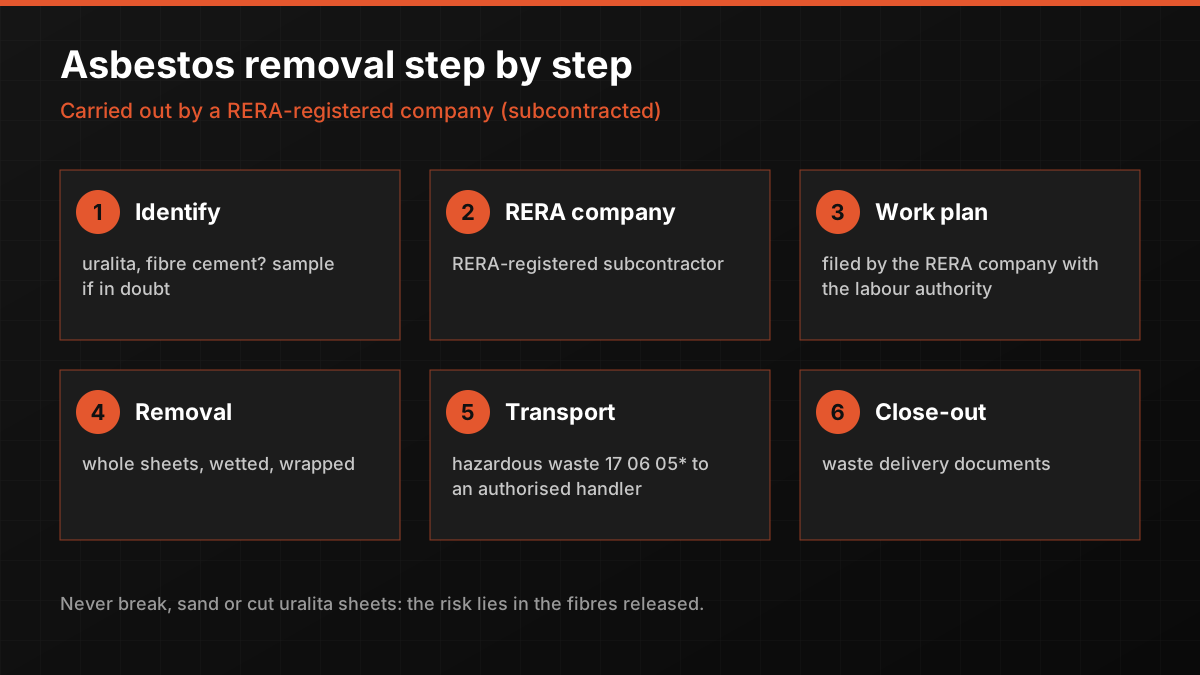
The order that works is always the same, and it is the one we follow:
- Survey the whole building, including offices, outbuildings and pipework, and photograph anything that looks like fibre cement.
- Agree the scope with the RERA-registered subcontractor, which prepares and files its work plan.
- Owner empties the building of stock, oils and chemicals; utilities are disconnected.
- Asbestos removal under the approved plan, with the waste leaving separately.
- Strip-out and machine demolition of the structure, fraction by fraction.
- Slab and foundations if included, final clean-up and delivery receipts.
The documentation for the demolition itself is prepared and signed by your técnico, and the declaración responsable or licence is filed by you with the town hall. We work with that documentation and coordinate dates. For the general sequence of an industrial demolition, see our guide on warehouse demolition phases and planning.
Sources
Frequently asked questions
Can a warehouse with an uralita roof be demolished with a machine?
Not until the asbestos material has been removed. A RERA-registered company removes it under an approved work plan first, and only then does the machine demolition start.
Are you registered in the RERA?
No. When a warehouse has asbestos, a RERA-registered subcontractor removes it first under its own work plan; our machines only start on the building once that phase is closed.
Which law regulates asbestos work in Spain now?
Real Decreto 847/2026, in force since late October 2026, which replaced Real Decreto 396/2006.
Where else can asbestos appear in an old warehouse?
In gutters, downpipes, flue pipes, water tanks, office cladding and old buried pipes, as well as in the roof sheets.
Who approves the asbestos work plan?
The labour authority of the province where the work is done; in Andalusia, the territorial delegation of the labour Consejería.
Can asbestos sheets go in the rubble skip?
Never. They are hazardous waste with code 17 06 05* and must be kept separate from all other waste.
Does the asbestos removal delay the demolition?
It adds a phase that must be completed first, including the approval of the work plan. Planning it from the start prevents idle machines and missed dates.
What if more asbestos is found during the job?
Work in that area stops and the specialised company plans the additional removal before the demolition continues there.
Is it dangerous to walk on a fibre-cement roof?
Yes. The sheets are fragile and can give way, so roof access is planned by the specialised company with proper fall protection.
Do private owners have to remove asbestos by a certain date?
The law does not set a general removal deadline for private owners; it obliged town halls to draw up asbestos censuses. Removal becomes necessary when the building is demolished or the material is disturbed.
Can you coordinate everything if I am abroad?
Yes. We coordinate the subcontractor and the demolition and keep you updated in English, while your técnico handles the documentation.