
In short
We demolish mass and reinforced concrete with excavator-mounted breakers, crushers and shears, choosing the tool for each element and the surroundings. The rebar is freed and separated, the concrete leaves as a clean fraction or is crushed on site, and dust is controlled with water at the point of work.
Contents
- What counts as concrete demolition?
- Breaker, crusher or shears: which tool for which element?
- Demolishing reinforced concrete frames and multi-storey structures
- Concrete floor removal inside buildings that stay
- Separating the steel from the concrete
- Dust, noise and vibration on concrete demolition
- From concrete demolition to concrete crushing
- Frequently asked questions
What counts as concrete demolition?
Concrete demolition is the breaking and removal of any structure or element made of concrete: reinforced concrete frames, columns and floors of multi-storey buildings, retaining and basement walls, industrial floors, loading docks, ramps, plinths for machinery, water tanks and bridges or walkways on private land. It may be the whole of a job or one phase of a larger demolition.
Two variables decide how the work is done. The first is reinforcement: mass concrete breaks predictably, while reinforced concrete has a steel cage that holds pieces together. The second is what is around the element: open ground allows heavy breaking, while an adjoining building, a party wall or occupied premises call for lower-vibration methods. The guide to reinforced concrete demolition techniques explains both in depth.
Breaker, crusher or shears: which tool for which element?
Each hydraulic attachment works in a different way, and using the right one saves time and reduces disturbance.
| Attachment | How it works | Typical use |
|---|---|---|
| Hydraulic breaker | Repeated impact on a point | Mass concrete, thick slabs, foundations, rock-like elements |
| Crusher or pulveriser | Jaws close and crush the concrete | Reinforced walls, columns and floors; frees the rebar |
| Demolition shears | Blades cut steel and thin concrete | Steel sections, rebar, light concrete elements |
| Grab or sorting grapple | Picks, sorts and loads | Separating fractions and loading |
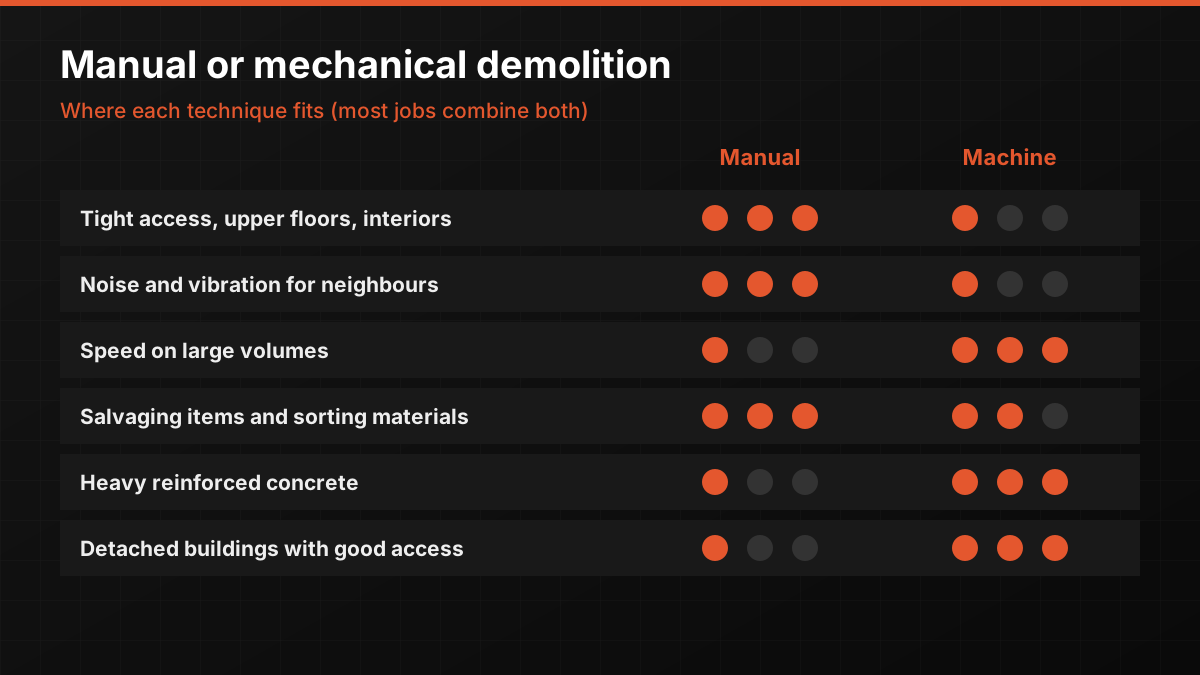
A crusher produces less vibration and noise than a breaker and is usually preferred near other buildings. A breaker is still the most effective tool on very thick, lightly reinforced elements. On most jobs both are used, often on the same machine with a quick-change coupling, as the photos on this site show.
Demolishing reinforced concrete frames and multi-storey structures
Multi-storey reinforced concrete buildings are demolished from the top down, one storey at a time, so that each floor is supported by the one below until it is taken. The machine works from the ground with a reach long enough for the top floor, or from a stable platform of rubble when the height allows it. The photo at the top of this page shows a crusher working on a reinforced concrete building of several storeys, with water spray at the point of contact.
The sequence is set out in the técnico's documentation and followed on site: slabs are crushed between beams, beams and columns are taken in an order that keeps the remaining structure stable, and debris is pulled inwards rather than allowed to fall towards the street or the neighbours. Tall structures may call for high-reach machine demolition.
Concrete floor removal inside buildings that stay
Concrete floor removal inside an existing building is a different problem: limited headroom, columns to work around, a roof overhead and often other people working in the rest of the building. Small machines with breakers, saw cutting along the edges and hand-held electric breakers in tight spots are typical tools.
Before breaking any floor inside a building, the técnico confirms that the slab is not part of the structure in a way that matters for the rest of the building, and services embedded in it are located. When the job is mostly interior strip-out with a concrete floor as one element, our sister site Demolición Interior Málaga covers floors and ceilings removal with hand and small-machine methods.
Separating the steel from the concrete
Reinforced concrete becomes two waste streams: concrete (17 01 01) and iron and steel (17 04 05). The cleaner the separation, the simpler the delivery to authorised facilities and the more useful the concrete for crushing.
The crusher does most of the work, breaking the concrete away from the bars. Remaining bars are cut with shears and set aside in their own pile, and a sorting grapple picks out what the crusher misses. Concrete with steel still attached causes problems at the crusher and at the receiving facility, which is why we separate before loading rather than after. Since 2022 Spanish waste law requires this kind of sorting into fractions, as our guide to EWC/LER codes shows.
Concrete elements sometimes carry other materials: tiles or screeds on floors, bitumen on roof slabs, insulation on walls, embedded pipes or cable ducts. Those are removed or broken off before the concrete is loaded, so that what reaches the facility, or the crusher, is concrete and nothing else. On older buildings, a técnico's survey of hazardous materials before work starts tells everyone what to expect.
Dust, noise and vibration on concrete demolition
Breaking concrete produces fine dust, impact noise and ground vibration. All three are controlled rather than eliminated, and the measures depend on how close the nearest people and buildings are.
- Dust: water spray or mist aimed at the point of breaking, wetting of rubble piles and loads, and stopping work in strong wind towards neighbours.
- Noise: working hours agreed with the site and the town hall's rules, crushers instead of breakers where possible, and planning the noisiest phases.
- Vibration: lower-energy tools near sensitive structures, cutting rather than breaking at boundaries and, where the técnico requires it, monitoring.
The guide to dust and vibration control explains each measure and when it is used.
From concrete demolition to concrete crushing
Large quantities of clean concrete from a demolition can be crushed into graded aggregate with a mobile jaw crusher, either on site or at an authorised facility. On-site concrete crushing is worth considering when the volume is large, there is space to work and stockpile, and the aggregate has a use that the project accepts.
The post asking whether on-site crushing is worth it weighs the advantages against the cost of bringing a crusher to site, and our crushing and recycling service page explains how it is organised.
Frequently asked questions
Is reinforced concrete harder to demolish than brick?
Yes. The steel cage holds pieces together, so the concrete must be crushed or cut to free it, and the steel separated as its own fraction.
Can you demolish concrete next to a building that stays?
Yes, with crushers, cutting and lower-energy tools at the boundary, following the sequence set by the técnico.
Do you use explosives?
No. Our concrete demolition is done mechanically with excavator-mounted attachments and, where needed, by hand.
How is dust controlled when breaking concrete?
With water spray or mist at the point of work, wetting of rubble and loads, and pausing work when wind blows towards neighbours.
What happens to the rebar?
It is freed from the concrete, cut and separated as iron and steel, then delivered to an authorised facility.
Can you remove a concrete floor inside a warehouse?
Yes. Inside buildings we use smaller machines, saw cutting and hand-held breakers, after the técnico confirms the floor can be removed safely.
How long does concrete removal take?
It depends on volume, thickness, reinforcement and access. We give an estimated schedule with the quote.
Can broken concrete be crushed on site?
Yes, if there is enough clean concrete, space for the crusher and a use for the aggregate that your project accepts.
Do I need a permit for concrete removal?
It depends on the works and the municipality. Removing concrete as part of a demolition falls under that demolition's procedure; check other cases with your técnico or the ayuntamiento.
Do you demolish concrete retaining walls?
Yes. Retaining walls are demolished in a sequence that keeps the ground behind them stable, as specified by the técnico.