In short
Machine demolition uses hydraulic excavators fitted with interchangeable attachments: breakers for hammering through hard concrete, crushers that bite concrete and expose rebar, shears that cut steel, and sorting grapples that separate materials on the ground. Long-reach (high-reach) excavators take tall buildings down top-down from a safe distance; the choice of machine and tool depends on structure, height, neighbours and waste sorting.

Contents
- What is machine demolition?
- Which attachments are used and what does each do?
- Breaker or crusher: which is better for concrete?
- What is high-reach or long-reach demolition?
- How is a machine demolition sequenced?
- Choosing the machine size and positioning it
- When is manual demolition still the better choice?
- Dust, noise and vibration from machines
- What to ask a contractor about the machines
- Frequently asked questions
What is machine demolition?
Machine demolition – also called mechanical demolition – is the dismantling of a structure with hydraulic plant rather than hand tools. In practice the base machine is almost always a tracked excavator, and the work is done by the attachment fitted to the end of its arm. Changing the attachment changes the job: the same machine can break a slab in the morning, cut steel beams after lunch and sort rubble in the afternoon.
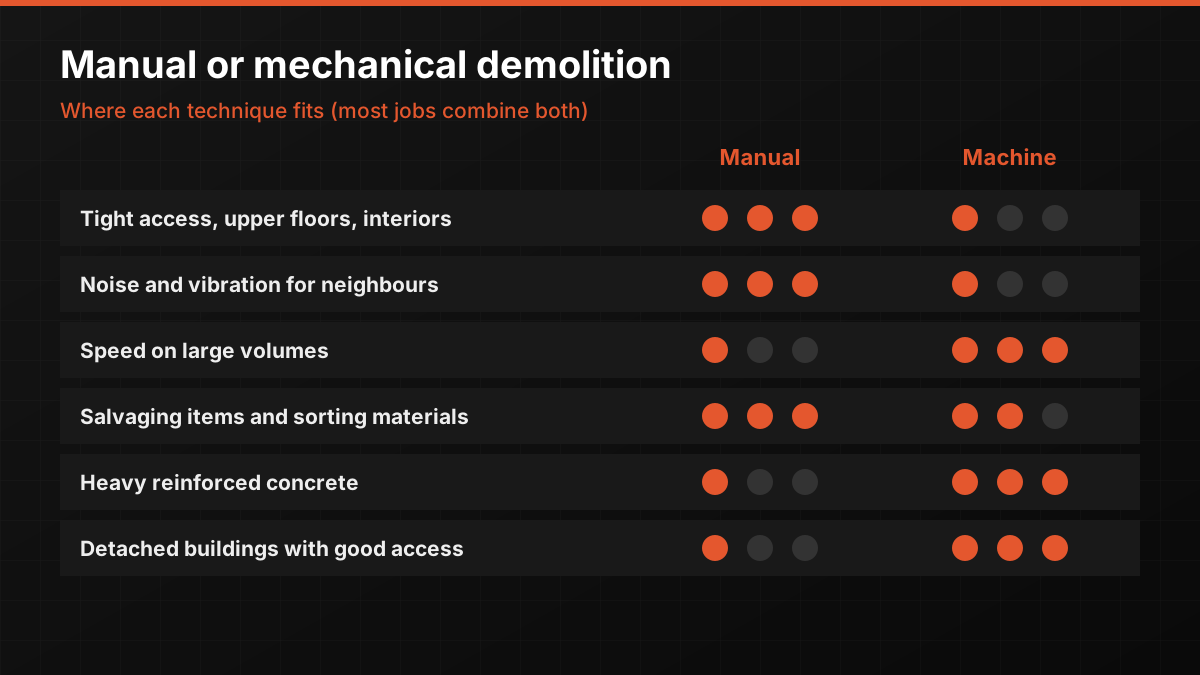
Mechanical methods are faster and safer than hand demolition for large or heavy structures, because the operator works from a protected cab at a distance from the element being demolished. They are less suitable for delicate work against a neighbour's wall or inside an occupied building, which is where manual techniques still lead. Most real jobs combine the two.
Which attachments are used and what does each do?
| Attachment | How it works | Best for | Limits |
|---|---|---|---|
| Hydraulic breaker (hammer) | A piston drives a chisel point into the material at high frequency | Thick slabs, foundations, rock-hard mass concrete | Noise and vibration; slow on reinforced elements with dense rebar |
| Crusher / pulveriser | Hydraulic jaws bite and crush concrete, freeing the reinforcement | Reinforced concrete walls, slabs, columns, precast elements | Needs an edge to bite; very thick mass concrete may need a breaker first |
| Demolition shears | Rotating blades cut through steel sections and bars | Steel portal frames, purlins, pipework, rebar bundles | Not designed for breaking concrete |
| Combi or multi-processor | A body with interchangeable jaw sets (crush, cut) | Mixed structures where the operator alternates tasks | Changing jaws takes time; compromise on each task |
| Sorting / demolition grapple | Rotating grab that picks, separates and loads | Selective demolition, separating wood, steel and masonry, loading skips | Not a breaking tool |
| Bucket | Standard digging bucket | Excavating around foundations, loading soil, levelling | Pushing walls over with a bucket is uncontrolled and avoided |
The photos on this site show several of these in use on our jobs: a crusher on a reinforced concrete building with water spray, shears on a concrete-block industrial building and a breaker on ground beams beside a steel hall.
Breaker or crusher: which is better for concrete?
Both break concrete, but in different ways. A breaker hammers: it is unbeatable on thick, unreinforced or lightly reinforced mass – foundations, pile caps, old floor slabs on the ground. It transmits vibration into the ground and makes the loudest noise on a demolition site. A crusher bites: it closes its jaws on an edge of the concrete and crushes it, which is quieter, produces less vibration and exposes the rebar so it can be separated cleanly.
On a reinforced concrete frame the crusher usually does most of the work; on a slab-on-ground it is common to start with the breaker and finish with the crusher on the broken pieces. Our guide on reinforced concrete demolition techniques goes deeper, and the concrete demolition service page explains how we price and plan this kind of work.
What is high-reach or long-reach demolition?
A high-reach (or long-reach) excavator is a demolition machine with an extended, multi-section boom that lets it work on the upper floors of a building from the ground. Instead of a crane or of workers on the roof, the operator takes the building down from the top, floor by floor, with a crusher or shears on the tip of the boom. The machine stands outside the collapse zone and debris falls inside the building's footprint.

The photo shows a long-reach machine taking down a four-storey industrial building top-down. High reach is the right choice when a building is too tall for a standard excavator, when it stands close to a road or other buildings and has to come down in a controlled way, or when the structure is too unsafe for people to work on it. It is not needed for a single-storey nave, where a standard excavator with shears does the job. Our blog post Who needs high-reach demolition? looks at the decision from the owner's side.
How is a machine demolition sequenced?
Good mechanical demolition follows a sequence that keeps the structure stable and the fractions clean:
- Exclusion zone. The area within reach of the machine and of falling debris is fenced and kept clear of people.
- Soft strip completed. Non-structural materials have been removed by hand beforehand, and any asbestos has been removed by a RERA-registered company.
- Top-down, inside-out. The roof and upper elements come down first; walls are pulled inwards, away from boundaries and streets.
- Element by element. The operator removes members in an order that never leaves a heavy part hanging unsupported – the bracing logic of the frame is read before cutting.
- Processing on the ground. Large pieces are crushed, rebar is pulled out, steel is cut to size and the grapple sorts the fractions into separate stockpiles.
- Loading out. Each fraction is loaded into skips or lorries for an authorised facility, or stockpiled for crushing.
The overall method and its safety measures are defined in the técnico's estudio de seguridad y salud and the contractor's plan de seguridad y salud under RD 1627/1997. How we apply this on site is described in How we run a machine demolition.
Choosing the machine size and positioning it
Bigger is not automatically better. The right machine is the one that reaches every element from a stable position, fits the access route and the working space, and does not overload the ground it stands on. A narrow plot between houses calls for a compact excavator and more hand work along the boundaries; an open industrial site allows a heavier machine that processes material faster.
Positioning matters as much as size. The machine works from solid ground or from a compacted rubble platform, never from a slab that may be undermined or a basement roof that may collapse. On sloping plots – common in the hills behind the Costa del Sol – the platform is levelled before the heavy work starts. The weight of the machine also affects the access route: a low-loader needs space to unload, and the route across the site may need protecting if a slab is to be kept.
When is manual demolition still the better choice?
Machines are not the answer everywhere. Hand work remains the right method for party walls shared with a neighbour, for interiors where the building stays occupied, for spaces a machine cannot reach and for heritage elements that must be dismantled piece by piece. Many of our industrial jobs start with a manual phase – soft strip, separation along boundaries – before the excavator arrives.
For interior and hand demolition, the sister site Demolición Interior Málaga has a dedicated hand demolition service. On this site, the machine demolition service covers whole buildings, frames and heavy concrete, and the warehouse and industrial demolition service puts the two methods together for naves and factories.
Dust, noise and vibration from machines
Every attachment has an environmental signature. Breakers are the main source of noise and ground vibration; crushers and shears are quieter but still produce dust when concrete breaks. Water spray or mist directed at the point of work, as in several of our photos, is the standard response to dust, together with sensible sequencing when the wind blows towards neighbours.
Vibration is managed mostly by tool choice – crushing instead of hammering near sensitive structures – and by recording the condition of neighbouring buildings before the job starts. Our guide on dust and vibration control on demolition sites covers the measures in detail.
What to ask a contractor about the machines
Before you accept a quote for mechanical demolition, ask:
- Which attachments will be used for each part of the building – frame, walls, slab, foundations?
- Is a long-reach machine needed, and if not, how will the upper parts be taken down safely?
- How will the fractions be separated on the ground, and where will the stockpiles stand?
- How will dust be controlled, and is there water on site or will it be brought in?
- What exclusion zone is planned, and does it affect a street or a neighbour's access?
Clear answers to these questions say more about how a job will go than any brochure. If you want a rough price range first, the demolition calculator on Presupuesto Demolición explains which factors count.
Sources
Frequently asked questions
What is mechanical demolition?
The dismantling of a structure with hydraulic plant – usually a tracked excavator with interchangeable attachments – instead of hand tools.
What is the difference between a breaker and a crusher?
A breaker hammers a chisel into the material and suits thick mass concrete; a crusher bites and crushes concrete, producing less vibration and freeing the rebar.
What are demolition shears used for?
Cutting steel: portal frames, purlins, pipework and bundles of reinforcing bar. They are not designed to break concrete.
What is top-down demolition?
Taking a building down from the top floor downwards, usually with a long-reach excavator, so debris falls within the footprint and the structure stays stable.
When is a high-reach excavator needed?
When a building is too tall for a standard machine, stands close to roads or other buildings, or is too unsafe for people to work on its upper floors.
Can an excavator demolish a building next to my neighbour's house?
Yes, with care: the machine works away from the boundary and the party wall is usually separated by hand. Tool choice reduces vibration near the neighbour.
Is demolition with an excavator safer than by hand?
For large or heavy structures, generally yes, because the operator works from a protected cab outside the collapse zone. Hand work remains safer for delicate boundary or interior tasks.
What does a sorting grapple do?
It picks up, separates and loads materials, which is essential for selective demolition: wood, steel and masonry go to separate stockpiles.
Does machine demolition cause a lot of vibration?
Breakers transmit the most vibration; crushers and shears much less. Near sensitive buildings the method is chosen to limit it.
Can a machine demolish a building with an asbestos roof?
Not until the asbestos is removed. A RERA-registered company removes it first under an approved work plan; only then does mechanical demolition begin.
How long does a machine demolition take?
It depends on the size and structure of the building, any asbestos removal beforehand, access and how far the waste has to travel. We give a realistic schedule with the quote, not a standard figure.