In short
A warehouse demolition in Spain runs through a survey, the municipal procedure and technical documents, disconnection of services, soft strip, removal of any asbestos roof by a RERA-registered company, dismantling of the cladding and frame, breaking out the slab and foundations, and sorting and removal of waste. Selective demolition has been compulsory since 2024, so the order of phases is also a legal requirement.

Contents
- How is a warehouse demolished, in short?
- Phase 1: what should the pre-demolition survey cover?
- Phase 2: which permits and documents does a warehouse demolition need?
- Phases 3 and 4: disconnection, emptying and soft strip
- Phase 5: the asbestos roof comes off first
- Phase 6: taking down cladding and the structural frame
- Phase 7: slab, ground beams and foundations
- Phase 8: sorting, crushing and handover of the plot
- Planning points that change the schedule
- Frequently asked questions
How is a warehouse demolished, in short?
A warehouse (nave industrial) is demolished from the inside out and from the top down: first everything that is not structure is removed, then the roof, then the cladding and frame, and only at the end the floor slab and foundations. Each step produces a different kind of waste, and keeping those steps apart is what makes the job selective, as Spanish law has required since 1 January 2024.
The phases below are the ones we plan on every industrial job in the province of Málaga, whether the building is a small workshop in a polígono or a long steel-framed storage hall on rural land.
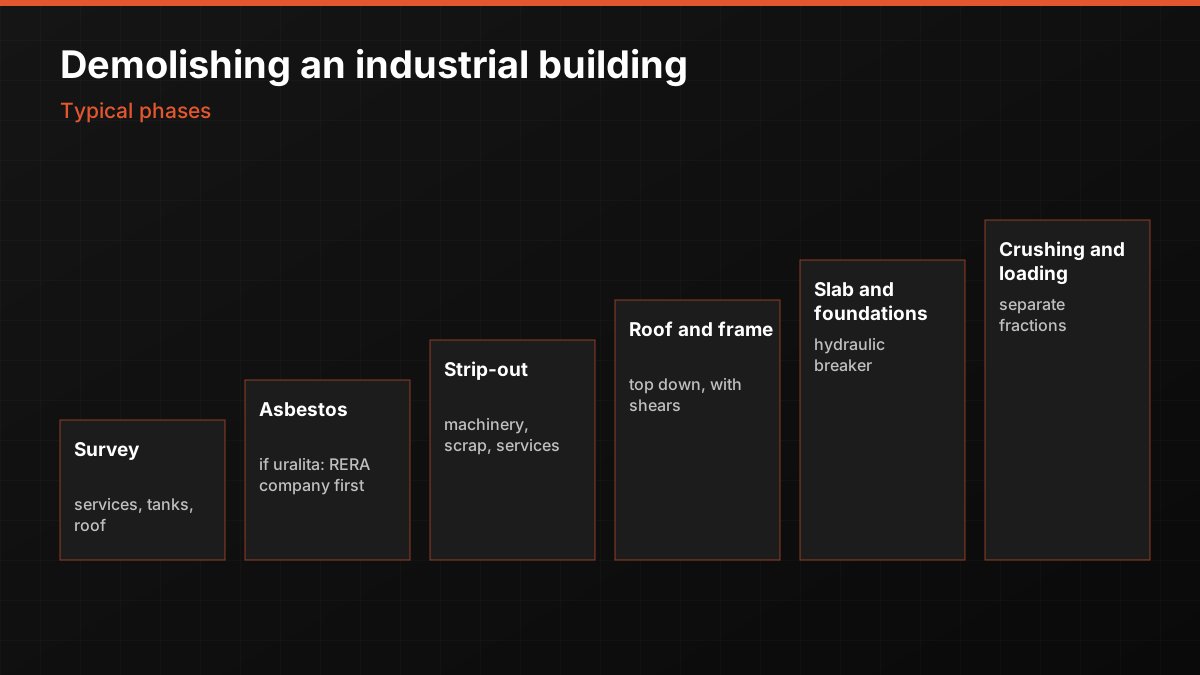
- Survey and information gathering
- Municipal procedure and technical documents
- Disconnection of services and emptying of the building
- Soft strip
- Asbestos roof removal, where present
- Cladding and structural frame
- Slab, ground beams and foundations
- Sorting, crushing or removal of waste and handover of the plot
Phase 1: what should the pre-demolition survey cover?
The survey answers three questions: what the building is made of, what is inside it and how machines will reach it. On a warehouse we look at the roof covering (metal sheet, sandwich panel or fibre cement), the frame (steel portal, precast concrete or in-situ concrete), the walls (concrete block, brick, panels), any mezzanines and offices, and the thickness and condition of the slab where it can be seen.
Just as important is what the previous use has left behind. Industrial buildings can contain tanks, pits, oil separators, compressors, racking, electrical cabinets and drums of product. Anything that contains residues has to be emptied and dealt with by the owner or operator through an authorised route before demolition; we plan around it but do not take liquids or chemicals into the rubble stream.
Finally, access. Low-loaders need a route in for the excavator, lorries need space to turn, and a polígono with shared roads and neighbouring units running every day needs a plan for deliveries and loading. Photos of the street, the gate and the adjoining buildings are as useful to us at quote stage as photos of the building itself.
Phase 2: which permits and documents does a warehouse demolition need?
In Andalusia, since Decreto-ley 3/2024, the total or partial demolition of a building that is not protected and not within a protected setting goes through a declaración responsable filed with the ayuntamiento (RGLISTA art. 293.1.e). Protected buildings, buildings in a protected setting and sites in archaeological zones still need a licencia urbanística. Each town hall sets the documents it wants in its ordinance; in Málaga city, the OMLU asks for a proyecto or memoria técnica signed by a técnico competente plus a certificado técnico, a separate document if the works occupy the public road, and photographs.
The technical side is the técnico's job. The demolition documentation – project or technical report, estudio de seguridad y salud or estudio básico under RD 1627/1997, and estudio de gestión de residuos under RD 105/2008 – is drafted and signed by a técnico competente. From those, the contractor prepares its own plan de seguridad y salud and plan de gestión de residuos. Where several companies or self-employed workers take part – which is the case whenever an asbestos subcontractor is involved – the promotor appoints a coordinador de seguridad y salud for the execution phase.
We do not obtain licences or sign technical reports; we work with your técnico's documentation and coordinate dates with them. For a broader view of the permit question, the pillar site explains demolition permits in Andalusia.
Phases 3 and 4: disconnection, emptying and soft strip
Before any machine touches the structure, electricity, water, gas and telecom connections are cut off and confirmed dead by the owner with the supply companies. The building is then emptied of stock, furniture, machinery and anything the owner wants to keep or sell. Reusable elements – gates, roller shutters, racking in good condition – are set aside, because the waste law asks for reusable items to be separated before demolition.
Soft strip follows. Offices, toilets and changing rooms inside the nave are stripped of plasterboard, false ceilings, doors, windows, insulation, cables, ducts and floor coverings. This is mainly manual work with small tools, and it is the step that keeps wood, plastic, glass and gypsum out of the concrete and brick that will be crushed or recycled later. Skipping it is the single most common reason a demolition ends up as mixed waste.
Phase 5: the asbestos roof comes off first
Many older warehouses in the province still have corrugated fibre-cement (uralita) roofs, gutters or downpipes. If a survey or sample confirms asbestos, that material is removed before any mechanical demolition. Under Real Decreto 847/2026, in force since late October 2026 and replacing RD 396/2006, only a company registered in the RERA may remove it, under a plan de trabajo approved by the provincial labour authority.
On our jobs that company works as our subcontractor: it prepares and files its own plan, removes and packs the sheets, and sends the waste (17 06 05*) to an authorised manager on separate documentation. We coordinate the rest of the demolition around its schedule. The sister site Retirada de Uralita Málaga covers asbestos in warehouses, and our blog looks at what can go wrong when a warehouse has an asbestos roof.
Phase 6: taking down cladding and the structural frame
With the roof clear, the envelope and frame are dismantled by machine. The method depends on the structure:
- Steel portal frames. Cladding sheets are removed, then purlins and rafters are cut with hydraulic shears from an excavator and lowered to the ground in a controlled order, bay by bay, so the frame never loses stability unexpectedly.
- Precast concrete frames. Beams and columns are released at their joints and brought down, then broken on the ground with a crusher that separates the reinforcement.
- Concrete block or brick walls. Walls are pulled inwards, away from boundaries and neighbouring units, and processed on the ground.
- Multi-storey industrial buildings. Older mills and factories with several floors are taken down top-down with a long-reach excavator, as in the photo, so that the machine works from a safe distance and debris falls inside the footprint.

The machine side is explained in detail in our guide to machine demolition with excavators, shears and breakers, and on our machine demolition service page.
Phase 7: slab, ground beams and foundations
Once the frame is down and the steel has been stockpiled, the floor slab and foundations are broken out – if the project says so. Not every job removes them: a buyer may want to keep a sound slab as hardstanding, or the new project may reuse foundations. That is a decision for the owner and their técnico, and it should be written into the documentation before work starts, because it changes both the waste volume and the price.
Where the slab comes out, it is broken with a hydraulic breaker or crusher, the rebar mesh is separated, and the concrete is either loaded out or stockpiled for crushing. Ground beams and pad foundations are exposed and broken in the same way. Our slabs and foundations service covers this phase on its own when it is the whole job.
Phase 8: sorting, crushing and handover of the plot
The last phase turns the stockpiles into documented deliveries. Concrete and masonry go to a recycling facility or, on larger jobs with space and a use for the material, through a mobile crusher; our crushing and recycling page and the guide on on-site crushing explain when that pays off. Steel goes to a metal recycler. Each load to an authorised facility produces a delivery receipt that the owner keeps for the municipal file and for the waste deposit.
The plot is handed over cleared of demolition debris, with the basic levelling that the job specified. If you need a price range before calling anyone, the network's price site has a page on industrial demolition cost that explains the factors. For a quote on a specific warehouse, see our warehouse and industrial demolition service.
Planning points that change the schedule
A few factors move the timetable more than the size of the building does:
- Asbestos. The RERA company's plan has to be approved before removal starts, and the rest of the demolition waits for it.
- Neighbours. Shared walls with adjoining units mean manual or careful mechanical separation along the party line.
- Street occupation. Skips and lorries on a public road need municipal authorisation, and some streets only allow loading at certain times.
- Waste destinations. Distances to authorised facilities affect how many loads per day are practical.
- What stays. Keeping a slab, a boundary wall or part of the building requires a clear line on site and in the documentation.
Owners who manage the job from abroad can follow it remotely: we can send photo updates at the end of each phase, and you can write to us in English.
Sources
Frequently asked questions
How do you demolish a warehouse in Spain?
In phases: survey, municipal procedure and technical documents, disconnection and emptying, soft strip, asbestos removal if needed, cladding and frame, slab and foundations, and sorting and removal of waste.
Do I need a permit to demolish a warehouse in Spain?
In Andalusia, demolishing a building that is not protected is done by declaración responsable since Decreto-ley 3/2024; protected buildings, protected settings and archaeological zones need a licencia. Check the procedure with the town hall or your técnico.
Who prepares the demolition project for a nave?
A técnico competente drafts and signs the project or technical report, the health and safety study and the waste study. The contractor then prepares its own safety and waste plans.
Does the asbestos roof have to come off before demolition?
Yes. Asbestos materials are removed first by a RERA-registered company under an approved work plan, and only then does mechanical demolition start.
Can the warehouse slab be kept?
Yes, if the owner and the técnico decide so and it is written into the documentation. Keeping a sound slab reduces waste but has to suit the next use of the plot.
What happens to the steel frame?
It is cut with hydraulic shears, lowered in a controlled sequence, stockpiled separately and sent to a metal recycler as iron and steel (17 04 05).
What is soft strip?
The removal of non-structural materials – plasterboard, ceilings, doors, insulation, cables, plastics – before the structure is demolished, so these fractions stay out of the concrete and brick.
Who deals with tanks and pits in an old industrial building?
Any residues must be emptied and handled by the owner or operator through an authorised route before demolition. We plan the demolition around them but do not put liquids or chemicals into the rubble.
Do I need a safety coordinator for a warehouse demolition?
Under RD 1627/1997, when several companies or self-employed workers take part, the promotor appoints a coordinador de seguridad y salud during execution. That is usually the case when an asbestos subcontractor is involved.
Can I follow the demolition from abroad?
Yes. We can send photo updates as each phase ends and you can contact us in English; the paperwork is coordinated with your técnico.
What decides the cost of a warehouse demolition?
Structure type, size, asbestos, slab and foundations, access, neighbours and waste destinations. The price site of our network explains these factors and offers a calculator.