
In short
We demolish warehouses, steel halls, concrete-block workshops and older multi-storey factory buildings by machine, with hand work where the building touches one that stays. Plant, tanks and chimneys are dismantled as part of the job, materials are sorted into fractions and you receive the delivery receipts from an authorised facility.
Contents
- What is included in a warehouse demolition?
- Steel halls, block buildings and multi-storey factories: three different jobs
- Plant dismantling, tank removal and chimney demolition
- Before the machines: services, hazardous materials and strip-out
- Demolishing a unit that shares walls with others
- Who does what on a commercial demolition?
- Is full demolition always the right answer?
- Frequently asked questions
What is included in a warehouse demolition?
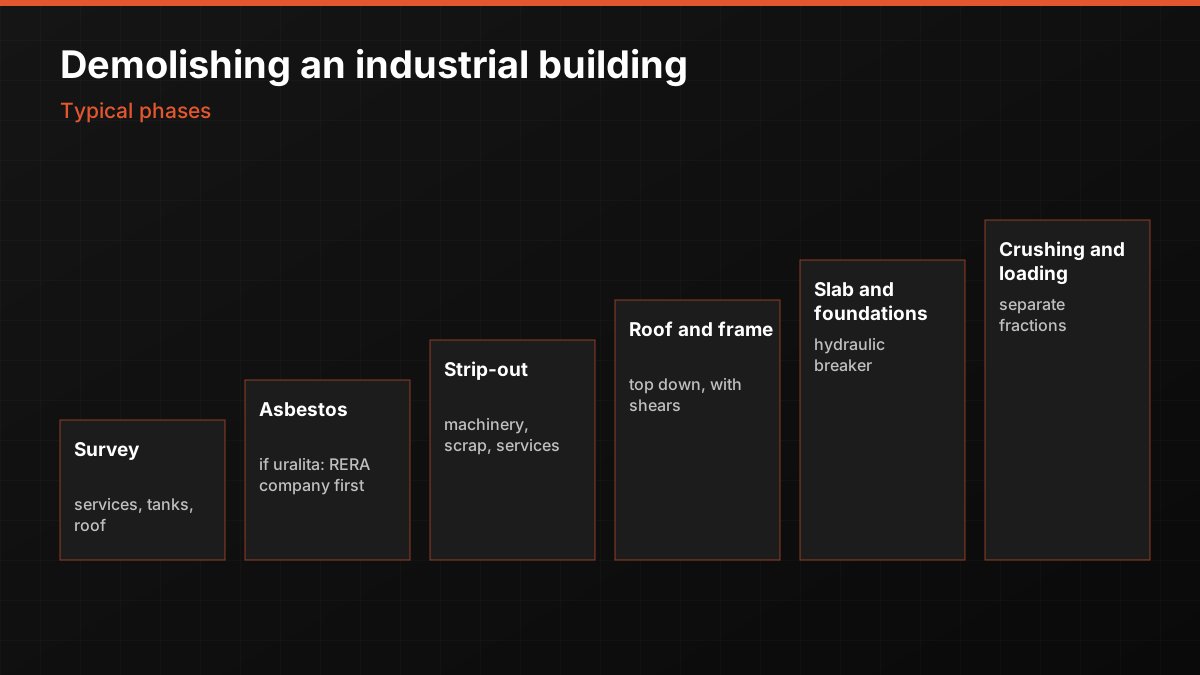
A complete warehouse demolition takes a building from operational or abandoned state to a cleared site: removal of what is left inside, separation of hazardous materials, dismantling of cladding, roof and installations, demolition of the structure and, if agreed, the floor slab and foundations. Each phase is priced and scheduled on its own, so you can see what is included and what belongs to someone else.
What a client usually wants at the end falls into one of three levels: the structure removed with the slab left as hardstanding; the slab broken out with foundations left in place where the new project allows it; or everything removed down to natural ground. Agreeing that level in writing before the quote is the single most useful decision you can make, and our page on slab and foundation removal explains what each level involves.
The guide to warehouse demolition phases and planning describes the sequence in detail, including the documents that should exist before work starts.
Steel halls, block buildings and multi-storey factories: three different jobs
Industrial buildings in the province of Málaga are not one type, and the method changes with the structure. Treating a 1970s concrete-framed factory like a modern steel shed is a common reason for delays.
- Steel portal-frame halls: cladding and roof sheets are removed first, then purlins and frames are cut with shears or by hot cutting and lowered in a controlled order. Most of the volume is steel, which separates cleanly.
- Concrete-block and brick buildings: walls are pulled in or cut down from the top with shears or a demolition grab, keeping debris inside the footprint. The photo on this page shows a block building being taken down this way with water mist.
- Older multi-storey factory and warehouse buildings: reinforced concrete frames or load-bearing masonry are demolished top-down, storey by storey, often with a long-reach machine so that no one works on the upper floors.
Mixed buildings are common: a block office annex attached to a steel hall, or a concrete loading dock in front of a light structure. We split those into zones and demolish each with its own method.
Plant dismantling, tank removal and chimney demolition
Industrial dismantling covers everything that is not the building itself: production lines, mezzanines, racking, gantries, silos, tanks and brick or steel chimneys. These elements are taken down before or alongside the structure, depending on how they are fixed and how heavy they are.
Tanks are only cut and removed once they have been emptied and cleaned. If a tank held fuel, oil or chemicals, its cleaning and any certification that the atmosphere inside is safe for cutting are arranged by the owner with a specialist before we start; tell us what each tank contained so that we can plan around it. Underground tanks are excavated and lifted out after that preparation.
Industrial chimneys are demolished from the top down in controlled sections, either with a long-reach machine or, where the height or surroundings require it, by hand from a working platform. Felling a chimney in one piece is only an option on very open sites, and it is a decision for the project, not an improvisation on the day.
Machinery and equipment the owner wants to keep or sell are removed by the owner or their buyer before demolition; we do not buy or sell reclaimed equipment.
Before the machines: services, hazardous materials and strip-out
Most problems on commercial demolition sites start before the first wall falls. Three things have to be settled first.
- Services disconnected. Electricity, water, gas and telecom supplies are cut and certified by the supply companies at the owner's request, not just switched off at the meter.
- Hazardous materials identified. Asbestos cement roofs and cladding, insulation, oils and residues from production are located and dealt with first. Asbestos is removed by a RERA-registered company working as our subcontractor, under its own approved work plan; our sister site explains the process for asbestos in warehouses.
- Strip-out and separation. Doors, glazing, false ceilings, plasterboard, cables and plastics are removed and separated so that the structural demolition produces clean concrete, masonry and steel.
The post on what can go wrong demolishing a warehouse with an asbestos roof shows what happens when this order is skipped.
Demolishing a unit that shares walls with others
On business parks many warehouses are built in rows, sharing a party wall or a roof line with the next unit. Demolishing one unit means protecting the others: their structure, roof drainage, fire separation and the operations going on inside.
The usual approach is to separate the building to be demolished from its neighbours first, often by hand or with a small machine, cutting the roof and frames along the boundary before the heavy machine works on the rest. Where the party wall stays, its exposed face may need protection or finishing as specified by the técnico. Vibration from breaking slabs next to occupied units and dust drifting into their doors are controlled with the measures described in our guide to dust and vibration control.
Agreeing working hours and access with the neighbouring tenants or the business park's management avoids most complaints. If the community of owners of an industrial estate has rules on access or loading areas, your representative should share them before the start date.
Who does what on a commercial demolition?
A commercial or industrial demolition involves several parties, and each has its own documents. Clarity here protects you if anything goes wrong.
| Party | Role |
|---|---|
| Owner or developer (promotor) | Files the declaración responsable or licence application, appoints the técnico and, when several companies work on site, a health and safety coordinator. |
| Técnico competente | Drafts and signs the proyecto or memoria técnica, the health and safety study and the waste management study. |
| Demolition contractor (us) | Prepares the health and safety plan and the waste management plan, executes the demolition, sorts and removes the waste and hands over the delivery receipts. |
| RERA-registered subcontractor | Prepares the asbestos work plan, has it approved and removes the asbestos-containing materials. |
The cost side depends on structure, height, materials, access and waste; the post on what drives the cost of demolishing a warehouse goes through each factor, and the calculator on Presupuesto Demolición gives an orientation band.
Is full demolition always the right answer?
Not always. An industrial building with a sound structure can sometimes be stripped back to its frame and re-clad, or partly demolished to free part of the plot while the rest keeps working. Whether that is viable depends on the structure, the planning status of the plot and the plans of the owner, and it is a question for your técnico before it is one for us.
The post on alternatives to full demolition of an industrial building compares the options. When the answer is partial demolition, the same principles apply: separate what stays from what goes, demolish towards the open side and keep the retained structure stable throughout. For the heavy part of the work we use machine demolition with the attachment that suits each element.
Frequently asked questions
How long does a warehouse demolition take?
It depends on size, structure, whether there is asbestos and how much of the slab and foundations comes out. We give a schedule with the quote, by phases.
Can you demolish a warehouse while the neighbouring units stay open?
Yes, with a sequence that separates the building first and controls dust and vibration. Working hours and access are agreed with the neighbours or the estate management.
Do you remove tanks?
Yes, once they have been emptied and cleaned. If a tank held fuel or chemicals, the owner arranges its cleaning with a specialist before we cut or lift it.
How is an industrial chimney demolished?
Normally from the top down in controlled sections, with a long-reach machine or by hand from a platform. Felling in one piece is only possible on very open sites and is decided in the project.
Do you dismantle production plant and racking?
Yes, as part of the demolition. Equipment you want to keep or sell has to be removed by you or your buyer beforehand.
Who files the paperwork for an industrial demolition?
The owner and their técnico file the declaración responsable or licence. We prepare our health and safety plan and waste management plan for the site.
My warehouse has an uralita roof. Can you still demolish it?
Yes. The asbestos cement roof is removed first by a RERA-registered company working as our subcontractor; then we demolish the rest.
Do you leave the slab or remove it?
Whichever you agree with us. The structure can be removed with the slab kept as hardstanding, or the slab and foundations broken out as well.
What happens to the steel frame?
It is cut, separated as iron and steel and delivered to an authorised facility. The receipts are part of the documentation you receive.
Can you demolish only part of an industrial building?
Yes. Partial demolition is planned so the retained part stays stable, following the técnico's documentation.