In short
On-site crushing uses a mobile crusher, fed by an excavator, to break clean concrete and masonry from a demolition into recycled aggregate, while a magnet removes the steel. It makes sense on larger jobs with enough space, clean input from selective demolition and a planned use for the aggregate; where and how that aggregate is reused is decided by the técnico within the project's waste documentation.

Contents
- What is on-site crushing?
- Which materials can be crushed – and which cannot?
- When does crushing on site make sense?
- Crushing on site or hauling away: how they compare
- What can recycled aggregate be used for?
- What does the law say about crushing demolition waste on site?
- How a crushing job is organised on site
- Questions to settle before booking a crusher
- Common mistakes with on-site crushing
- Frequently asked questions
What is on-site crushing?
On-site crushing means processing demolition rubble into aggregate on the demolition site itself, using a mobile crushing plant instead of sending the material to a fixed recycling facility. The crusher is a self-contained tracked unit: an excavator loads concrete and masonry into its hopper, a jaw chamber breaks the pieces down to a set size, and a conveyor discharges the product onto a stockpile. An overband magnet above the discharge belt pulls out the steel – mostly rebar fragments – which is collected separately.
The photo shows a tracked jaw crusher being fed by an excavator on one of our jobs. The result is a recycled aggregate whose grading depends on the crusher setting and, if a screen is used, on the sizes separated afterwards.
Which materials can be crushed – and which cannot?
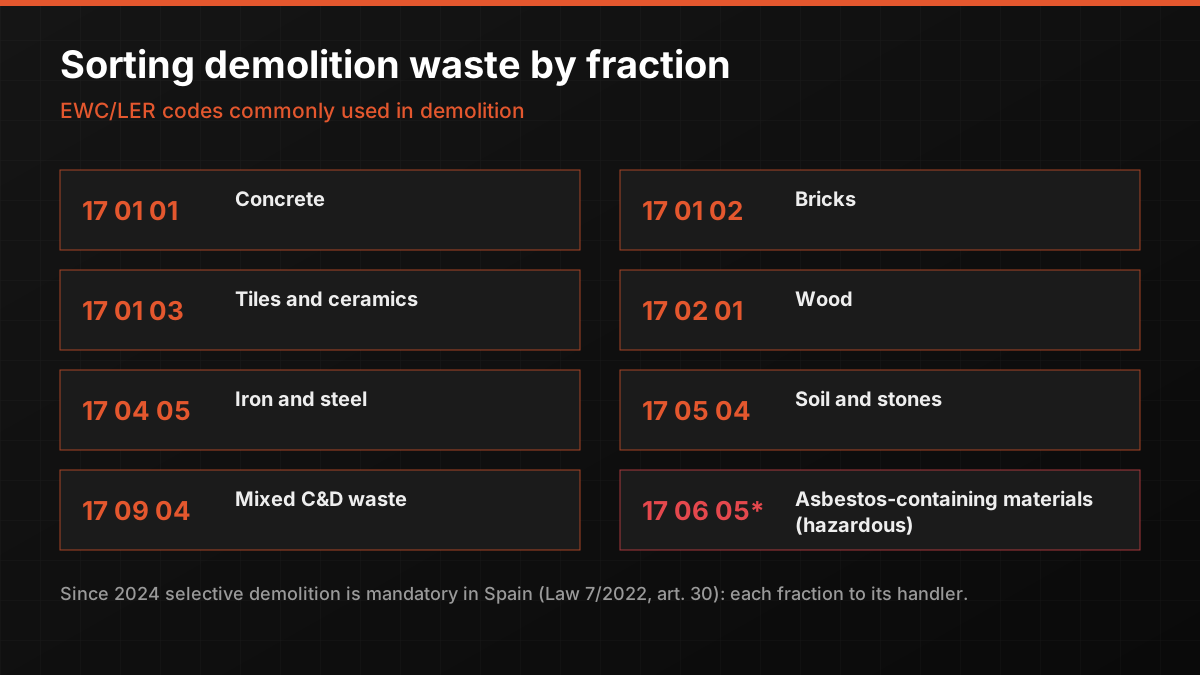
The crusher only produces useful aggregate from clean mineral material. In waste terms that means concrete (17 01 01), and depending on the intended use, bricks, tiles and ceramics (17 01 02, 17 01 03) or their mixtures (17 01 07). What it cannot do is clean up a contaminated heap:
- Wood, plastic, insulation and cables end up as fragments in the aggregate and spoil it.
- Plaster and plasterboard (17 08 02) are unwelcome because gypsum affects the quality of recycled aggregate.
- Soil mixed into the concrete dilutes the product and may make it unsuitable for the planned use.
- Asbestos-containing materials (17 06 05*) must never enter a crusher. They are removed beforehand by a RERA-registered company and delivered separately as hazardous waste.
This is why crushing and selective demolition go together. Since 1 January 2024 selective demolition is compulsory under Ley 7/2022, and it is also the only way to give a crusher the input it needs.
When does crushing on site make sense?
Crushing on site pays off when several conditions coincide:
- Enough volume. Bringing in and setting up a mobile plant is a fixed effort; it only makes sense when there is a substantial quantity of concrete or masonry – a large slab, a concrete frame building, an industrial yard.
- A use for the product. The biggest benefit appears when the aggregate stays on site as fill or as a working platform for the next project, so fewer lorries leave full and fewer arrive with bought-in material.
- Space. The crusher, the feed stockpile, the product stockpile and the excavator need room to work safely, with an exclusion zone around them.
- Tolerance of the surroundings. A crusher is noisy and produces dust. On an open industrial plot that is manageable; in a dense residential street it may not be appropriate.
When one of these is missing, sending clean concrete to a fixed recycling facility is usually the better route. Our blog post Is on-site crushing worth it? weighs the decision in more detail.
Crushing on site or hauling away: how they compare
| Factor | Crushing on site | Loading out to a facility |
|---|---|---|
| Lorry movements | Fewer, especially if aggregate is reused on site | Every tonne leaves by road |
| Space needed | Crusher, feed and product stockpiles, exclusion zone | Skips or loading area only |
| Noise and dust on site | Higher while the crusher runs | Lower on site; impact moves to the road |
| Input quality | Must be clean and well separated | Facility accepts by code and may reclassify mixed loads |
| Paperwork | Reuse must be foreseen in the waste documentation | Delivery receipts from the authorised manager |
| Best for | Large concrete volumes with a planned use on the plot | Small and medium jobs, tight urban sites |
For price comparisons, the factors that matter are volume, distance to facilities, the value of aggregate you no longer have to buy and the time the crusher is on site. The calculator on Presupuesto Demolición gives an indicative range for the demolition itself.
What can recycled aggregate be used for?
Recycled concrete aggregate is commonly used for non-structural purposes such as fill, sub-base under hardstanding, temporary site roads and working platforms. Whether a particular batch is suitable for a particular use depends on its grading, its cleanliness and the specification of the project that will use it – and that decision belongs to the técnico who designs that next project, not to the demolition contractor.
Two practical points follow. First, decide the use before crushing, so the crusher setting and any screening produce the size that use needs. Second, keep the product clean after crushing: a stockpile contaminated by soil or by plaster dust from a skip next to it loses its value. On plots where the aggregate will form the base for basic levelling after demolition, the sister site Demolición de Piscinas Costa del Sol explains groundworks and levelling in that context.
What does the law say about crushing demolition waste on site?
Crushed rubble starts its life as construction and demolition waste, so it sits inside the same framework as the rest of the job. Ley 7/2022 requires sorting by fraction and selective demolition; RD 105/2008 requires an estudio de gestión de residuos in the project, drafted by the técnico, and a plan de gestión by the contractor, approved by the dirección facultativa. If part of the concrete is to be crushed and reused on the same site, that intention belongs in those documents from the start.
Whether a particular site or use needs any further authorisation for mobile crushing, or for using the material outside the plot, is not something we state generically: check it with your técnico and, where applicable, the environmental authority (to be verified). What we do on our side is organise the crushing as part of the plan de gestión, keep the steel separated as 17 04 05 for a metal recycler and deliver any surplus or unsuitable material to an authorised manager with receipts. The wider responsibilities are set out in our guide on who is responsible for demolition waste in Spain.
How a crushing job is organised on site
When crushing is part of the plan, the work is laid out around the plant:
- Demolition and pre-processing. The building is taken down selectively; on the ground, the excavator with crusher jaws breaks large pieces to a size the mobile plant will accept and pulls out heavy rebar.
- Feed stockpile. Clean concrete and masonry are stockpiled near the crusher; anything doubtful is kept apart.
- Crushing. The excavator feeds the hopper at a steady rate; water spray at the feed and discharge points keeps dust down.
- Steel removal. The magnet separates remaining steel, which goes to its own container.
- Product stockpile and use. The aggregate is stockpiled for reuse or loaded out, as planned.
The demolition that precedes crushing is described on our concrete demolition and slabs and foundations pages; the crushing service itself is on the crushing and recycling page.
Questions to settle before booking a crusher
A mobile crusher is booked for a period, so the decisions around it are best made before it arrives rather than while it stands idle. Settle these points with your técnico and with us at quote stage:
- Which fractions go in. Only concrete, or concrete plus brick and ceramics? The answer depends on the use of the product.
- Which size comes out. Fill, sub-base and working platforms usually call for different gradings; the crusher setting and any screening follow from that choice.
- Where the product goes. A defined area of the plot, a future building platform, or partly off site to a facility.
- How much will be surplus. Material that cannot be used on site still needs a destination and receipts.
- When it runs. Crushing days are noisier and dustier than the rest of the job, so they are best announced to neighbours and kept within the hours the town hall allows.
With those answers written down, the crusher spends its time producing aggregate you can use instead of a pile you will pay to move twice.
Common mistakes with on-site crushing
- Crushing without a use. A mountain of aggregate with nowhere to go still has to be loaded and transported.
- Skipping soft strip. Fragments of plastic and wood in the product make it unsuitable for most uses.
- Crushing next to the plasterboard skip. Gypsum dust and pieces end up in the product.
- Ignoring the neighbours. A crusher running all day beside occupied homes causes complaints even when it is legal.
- Not documenting the reuse. If crushed material stays on site without being foreseen in the waste documentation, the receipts at the end will not match the waste study.
Where crushing is not worthwhile, clean fractions still go to recycling facilities rather than landfill. That logistics side is covered by our rubble removal and skips service.
Sources
Frequently asked questions
What is a mobile crusher?
A tracked crushing plant that can be brought to a demolition site. An excavator feeds rubble into its jaw chamber, the crushed material leaves on a conveyor and a magnet separates the steel.
Can all demolition rubble be crushed?
No. Only clean mineral material such as concrete, and depending on the use brick and ceramics, makes good aggregate. Wood, plastic, gypsum and soil spoil the product.
Can asbestos be crushed with the rest of the rubble?
Never. Asbestos materials are removed by a RERA-registered company before demolition and delivered separately as hazardous waste.
What is recycled aggregate used for?
Commonly for non-structural uses such as fill, sub-base, site roads and working platforms. The técnico of the next project decides whether a batch is suitable.
Is it cheaper to crush concrete on site?
It can be when the volume is large and the aggregate is reused on the plot, because fewer lorries are needed. On small jobs, hauling clean concrete to a recycling facility is often simpler.
How much space does a crusher need?
Enough for the plant, the feed and product stockpiles, the feeding excavator and a safety exclusion zone. Tight urban plots often cannot accommodate it.
Is on-site crushing noisy?
Yes, crushers are noisy and produce dust while running. Water spray limits the dust, and the decision to crush on site takes the neighbours into account.
What happens to the rebar in crushed concrete?
Large bars are pulled out by the excavator before crushing, and the crusher's magnet separates the remaining steel. It goes to a metal recycler as iron and steel (17 04 05).
Do I need a permit to crush concrete on my plot?
The reuse should be planned in the project's waste documentation. Whether a specific site needs further authorisation is something to check with your técnico and the competent authority (to be verified).
Can crushed concrete be used to fill a swimming pool?
That depends on the infill specification set by the técnico for the plot. Clean, graded material is one option they may consider.
Can I keep the crushed material after the job?
Yes, if its reuse on your plot has been foreseen in the waste documentation. Tell us at quote stage so the crushing is planned for that use.