
In short
Demolition waste recycling starts with selective demolition: concrete, masonry, steel, wood and other fractions are separated on site. Clean concrete and masonry can be crushed with a mobile jaw crusher when volume, space and a use for the aggregate justify it; everything else goes to authorised facilities with delivery receipts.
Contents
- What does rubble recycling involve on a demolition?
- Which demolition rubble can be crushed?
- When does on-site crushing make sense?
- What can the crushed material be used for?
- Recycling beyond the crusher: steel, wood and the rest
- Paperwork: waste plan, receipts and deposit
- When recycling on site is not the right choice
- Frequently asked questions
What does rubble recycling involve on a demolition?
Recycling of rubble is not one operation but a chain: demolishing selectively so that materials come apart cleanly, separating them into fractions on site, processing the mineral fraction where that is useful, and delivering each fraction to the right authorised facility. A crusher is only the most visible link.
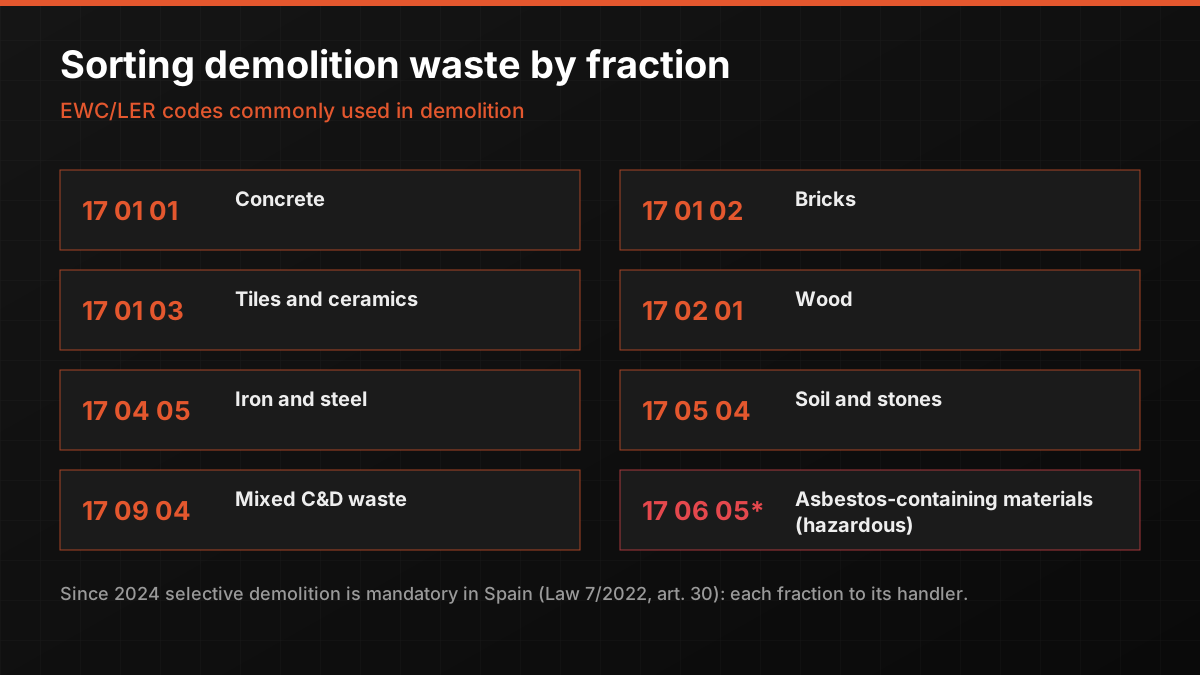
Spanish law sets the baseline. Ley 7/2022 requires non-hazardous construction and demolition waste to be sorted at least into wood, mineral fractions (concrete, bricks, tiles, ceramics and stone), metals, glass, plastic and gypsum since 1 July 2022, with reusable elements set aside, and makes selective demolition mandatory since 1 January 2024. A demolition contractor in Andalusia that still loads everything into one mixed skip is not working to the current rules.
Our guide to on-site crushing and recycled aggregates sets out the technical side, and the EWC/LER codes guide lists the codes used for each fraction.
Which demolition rubble can be crushed?
A jaw crusher processes mineral rubble: concrete, brick, block, tiles, ceramics and stone. The cleaner the input, the better the aggregate. Steel left in concrete, timber, plastics, plaster and soil reduce its quality and can damage the machine, which is why sorting comes before crushing.
- Good input: concrete from slabs, frames and foundations with the rebar removed; clean brick and block masonry.
- Acceptable with care: mixed concrete and masonry (17 01 07), provided it is free of other materials.
- Not suitable: gypsum and plaster, wood, plastics, insulation, soil-heavy rubble and anything that may contain asbestos.
Asbestos-containing material is never crushed or mixed: it is removed beforehand by a RERA-registered company and travels as hazardous waste (17 06 05*).
Within the suitable material, the crusher's settings decide the size of the output. A finer grading suits sub-base or pipe bedding, a coarser one suits fill or a working platform. The grading is chosen with the end use in mind, which again points back to what the project needs from the aggregate.
When does on-site crushing make sense?
On-site crushing works when four conditions meet: a large volume of clean mineral rubble, enough space for the crusher, the feeding machine and the stockpiles, access for a heavy machine to arrive and leave, and a realistic use for the crushed material. If any of these is missing, sending the sorted rubble to an authorised facility is usually the better option.
The photos on this page show a typical set-up: a mobile jaw crusher fed by an excavator, with the crushed material discharged onto a stockpile by conveyor. The crusher's own dust and noise are part of the site's control plan, which our dust and vibration guide covers.
The post on whether on-site crushing is worth it works through the decision for a typical industrial plot.
What can the crushed material be used for?
Crushed concrete and masonry can serve as fill, sub-base or a working platform, depending on its grading and quality. Whether it can be reused on your site, and for what, is decided by your project and its técnico, not by the contractor who crushed it.
That is why the conversation about crushing starts with the project. If the new development needs fill or a platform for its own machines, crushing the demolition rubble on site may replace part of the material that would otherwise be brought in. If the project has no use for it, the aggregate still has to leave the site, and the gain is mainly in a denser, more manageable load. We do not sell crushed material.
If the aggregate is to stay on site, agree early where it will be stockpiled and when it will be placed, so that it does not block the rest of the demolition or the arrival of the next contractor.
Recycling beyond the crusher: steel, wood and the rest
A large part of industrial demolition waste never goes near a crusher. Steel frames, purlins, rebar, roof sheets and cladding are separated as iron and steel and delivered to an authorised facility. Timber from roofs, doors and pallets is a separate fraction, as are glass, plastics and gypsum-based materials such as plasterboard partitions.
Sorting happens as the building comes down. Strip-out removes the light materials first; the structural demolition then produces concrete, masonry and steel that a sorting grapple separates into piles. Loading by fraction, rather than mixing everything for speed, is what keeps each stream recyclable. The rubble removal and skips page describes how those fractions leave the site.
Paperwork: waste plan, receipts and deposit
Recycling is also a paper trail. Under Real Decreto 105/2008 the project includes a waste management study drafted by the técnico, and the contractor, as holder of the waste, prepares a waste management plan for the site, approved by the site's technical management. On our jobs that plan is part of our work.
Every load delivered to an authorised facility generates a receipt. Those receipts are what the town hall checks before returning the deposit or guarantee for construction waste that it may require; the amount depends on the municipal ordinance. Our guide to waste deposits in Andalusia explains the mechanism, and the post on mistakes when managing demolition waste in Spain covers the errors that delay its return.
When recycling on site is not the right choice
Small volumes, tight urban plots, neighbours close by and projects with no use for aggregate all argue against bringing a crusher to site. So does mixed rubble that would need extensive hand sorting before crushing. In those cases the sorted fractions are loaded and sent to authorised facilities, where they are processed anyway.
The choice is not all or nothing. On some jobs only the concrete from slabs and foundations is crushed, because it is the cleanest and largest stream, while masonry and mixed rubble leave directly. Deciding that split at the planning stage gives the most realistic picture of time and cost.
For the demolition itself, see our pages on concrete demolition and warehouse and industrial demolition. For orientation on how waste handling affects the overall cost, the rubble and skip cost page on Presupuesto Demolición lists the factors.
Frequently asked questions
Can you crush rubble on site?
Yes, when there is enough clean concrete or masonry, space for the crusher and stockpiles, and a use for the aggregate that your project accepts.
What is recycled from a demolition?
Concrete and masonry, steel, wood, glass, plastics and gypsum are separated into fractions and delivered to authorised facilities for recycling or treatment.
Can I reuse crushed rubble on my plot?
That depends on your project and its técnico, who decide whether the aggregate can be used as fill or sub-base and where.
Do you sell recycled aggregate?
No. Crushing is part of managing the waste of your own demolition, not a materials business.
Is sorting demolition waste compulsory in Spain?
Yes. Since 1 July 2022 non-hazardous demolition waste must be sorted at least into wood, mineral fractions, metals, glass, plastic and gypsum.
Can bricks be crushed with concrete?
Clean brick and block can be crushed with concrete as a mixed mineral fraction, as long as other materials have been removed.
What can't be crushed?
Plaster and gypsum, wood, plastics, insulation, soil-heavy rubble and anything that may contain asbestos are not crushed.
Does on-site crushing reduce lorry movements?
It can, especially if the aggregate stays on site. If it has to leave anyway, the gain is smaller.
Who prepares the waste management plan?
The contractor prepares the plan for the site from the técnico's waste management study, as Real Decreto 105/2008 provides.
Will I get proof that the waste was recycled?
You receive a delivery receipt from the authorised facility for every load that leaves the site.