
In short
Rubble from our demolitions is sorted on site and leaves by fraction in skips, rubble bags or directly on lorries, depending on volume and access. Each load goes to an authorised waste facility and you receive the delivery receipt. If a skip occupies the public road, the town hall's authorisation is needed first.
Contents
- Rubble removal as part of the demolition, not an afterthought
- Skip, rubble bags or loading straight onto a lorry?
- Why rubble is sorted before it is loaded
- Skips on the public road
- Where does the rubble go, and what proof do you get?
- Rubble that is not from our demolition
- Rubble removal versus soil removal
- Frequently asked questions
Rubble removal as part of the demolition, not an afterthought
Rubble removal is planned with the demolition from the first site visit, because the way rubble leaves the site shapes how the building comes down. Where the skips stand, how lorries turn, which fractions are loaded first and how much space the piles take all affect the sequence and the time.
On our jobs the rubble disposal is included in the demolition quote by fraction: concrete, masonry, mixed mineral rubble, steel, wood and the smaller streams. That way you see in one document what is removed, how and to what kind of destination, and nothing is left on site for someone else to deal with. If part of the rubble is to be crushed and kept on site, that is shown separately too. The photo on this page shows a typical moment: brick rubble from an old building being sorted and loaded by an excavator next to the walls of a basement.
Skip, rubble bags or loading straight onto a lorry?
The right container depends on volume, access and the type of rubble.
| Option | Suits | Limits |
|---|---|---|
| Rubble bags (big bags) | Small quantities, narrow streets, gardens, interior work | Low capacity per bag; handled by crane lorry |
| Skips | Small and medium demolitions, one skip per fraction | Need space on the plot or a road occupation permit |
| Direct loading onto lorries | Industrial demolitions and large volumes | Need room for the lorry to enter, turn and load |
On a warehouse or industrial plot, direct loading by excavator onto tipper lorries is usually the most efficient. On a villa or a town-centre building, skips or rubble bags are often the only practical choice. The post on skip or rubble bags: which one makes sense compares them in more detail.
Why rubble is sorted before it is loaded
Spanish waste law requires construction and demolition waste to be separated into fractions, and authorised facilities price and accept loads according to what they contain. A clean load of concrete and a mixed load of concrete, timber and plastic are two different things for the receiving facility.
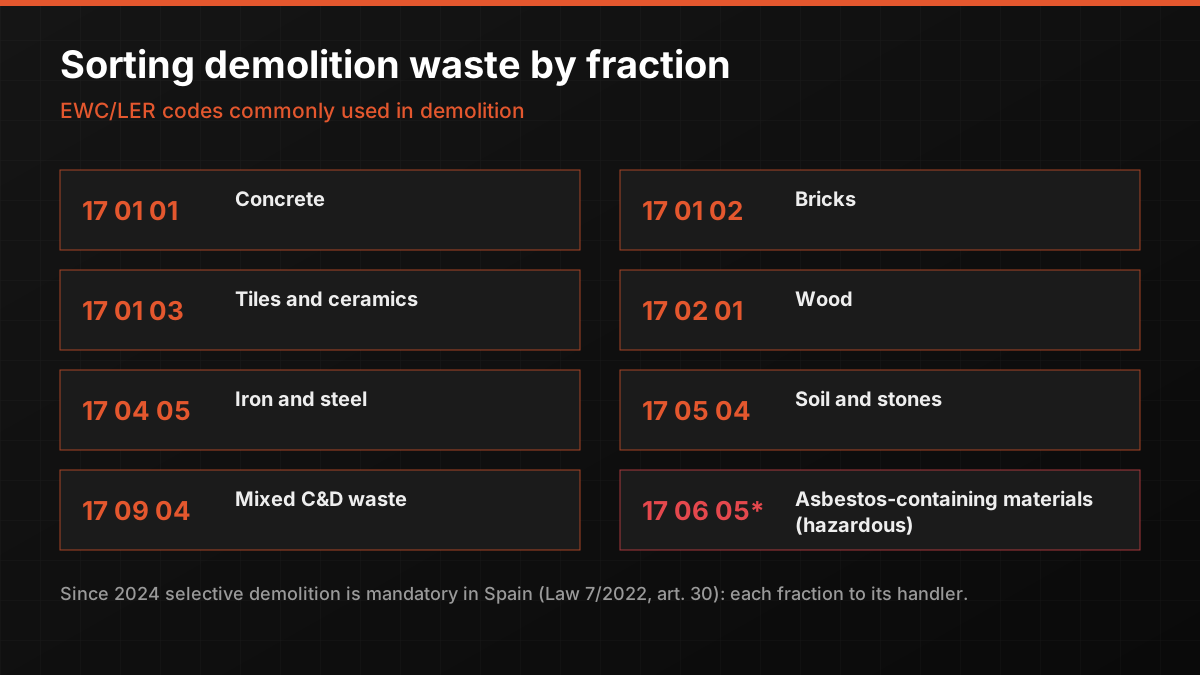
Sorting therefore happens as the building comes down, not at the skip. Light materials are removed during strip-out, the structure is demolished in a way that keeps materials apart, and a grab separates the piles before loading. Each skip or lorry then carries one fraction, identified by its EWC/LER code. Plasterboard and other gypsum-based materials, for example, travel apart from mineral rubble because they spoil it for recycling. Our guide to construction and demolition waste rules in Spain explains who is responsible for each step.
Skips on the public road
If a skip, rubble bags or stockpiled materials stand on the street or pavement, the town hall's authorisation for occupation of the public road is needed before work starts. Each ayuntamiento has its own procedure and fee; in Benalmádena, for example, a fiscal ordinance regulates occupation of the public road with skips and materials.
Where the plot has room, keeping skips inside avoids the procedure and the restrictions on hours and placement that come with it. Where it does not, the application is usually handled by the owner or their representative; we tell you the size and number of skips and the dates so that the application matches the work.
Lorries entering and leaving the site also affect the street: mud and dust on the road, reversing manoeuvres and loading times. On industrial estates this is rarely an issue; in residential streets and town centres, loading windows, wheel cleaning at the exit and a banksman for reversing are part of the plan. Mijas, for instance, requires prior authorisation for works that affect the public road, and other municipalities have similar rules.
Where does the rubble go, and what proof do you get?
Every load goes to an authorised waste facility suited to the fraction. You receive the delivery receipts, which document the quantity and type of waste delivered. Those receipts are the evidence your técnico needs for the end of works and the documents the town hall checks before returning any deposit or guarantee for construction waste it may have required.
The guide to waste deposits in Andalusia explains when a deposit applies and how it is recovered. Losing or never receiving receipts is one of the commonest problems described in our post on mistakes when managing demolition waste in Spain.
Rubble that is not from our demolition
Our rubble removal is organised around demolitions we carry out: the building, the concrete, the slab, the walls. If all you need is a skip for rubble you have produced yourself, or rubble left on a plot by a previous contractor, write to us with photos and the approximate volume and we will tell you whether we can help.
Old rubble heaps on plots can hide problems: broken asbestos cement sheets, mixed household waste or soil. Before loading, the heap is checked and any suspect material is set aside. Asbestos cement fragments are removed by a RERA-registered company working as our subcontractor; our sister site explains uralita removal in detail.
Rubble removal versus soil removal
Rubble and soil are different waste streams. Rubble is the mineral and other material from the demolition; soil and stones excavated from the ground have their own code (17 05 04) and their own destinations. Mixing them makes both harder to manage.
When slabs and foundations are broken out, some soil inevitably comes with the concrete. We keep the two as separate as the work allows, and excavation of natural ground for a new project is a separate scope for a groundworks contractor. See our page on slab and foundation removal for how below-ground work is organised, and for factors that affect the cost of skips and rubble, the calculator on Presupuesto Demolición.
Frequently asked questions
Is rubble removal included in your demolition quote?
Yes. Loading, transport and delivery to authorised facilities are included by fraction, so you can see what leaves the site and how.
Skip or rubble bags: which should I use?
Rubble bags suit small quantities and tight access; skips suit medium volumes with space; large demolitions are loaded straight onto lorries.
Do I need a permit to put a skip on the street?
Yes, occupying the public road with a skip needs the town hall's authorisation. Each ayuntamiento has its own procedure.
Can I dispose of rubble myself in Spain?
Small amounts from minor domestic repairs count as household waste. Demolition rubble has to go to an authorised facility, with proof of delivery.
Do I get receipts for the rubble?
Yes. You receive a delivery receipt from the authorised facility for each load.
Can you clear old rubble left on my plot?
Send us photos and the approximate volume and we will tell you whether we can help. The heap is checked for suspect materials first.
Why do you separate rubble into different skips?
Because the law requires sorting into fractions and facilities accept loads by type. Clean fractions are simpler to recycle and document.
What happens if there is asbestos in the rubble?
It is set aside and removed separately by a RERA-registered company, as hazardous waste that is never mixed with other rubble.
Is soil removed with the rubble?
Soil is a separate waste stream. We keep it apart from rubble as far as possible; bulk excavation belongs to a groundworks contractor.
How quickly is the rubble removed?
Loading follows the demolition sequence, so rubble leaves as each phase progresses rather than all at the end.