
In short
Machine demolition uses excavators fitted with crushers, shears, breakers and sorting grabs to bring structures down without people working on them. Tall buildings are taken top-down, sometimes with a long-reach configuration; the work is selective, with materials separated as they come down and the waste removed by fraction.
Contents
- What is mechanical demolition?
- How does top-down demolition work?
- When is high-reach demolition needed?
- Excavator attachments and what each one does
- Deconstruct and demolish: dismantling before demolition
- Asbestos roofing must come off before the machines start
- When a machine is not the right tool
- Frequently asked questions
What is mechanical demolition?
Mechanical demolition is the demolition of a structure with machines rather than by hand: tracked excavators fitted with hydraulic attachments that crush, cut, break and sort. It is the standard method for warehouses, industrial buildings, concrete structures and most whole-building demolitions, because it keeps operators out of the building and moves large volumes safely.
Demolition with an excavator is not a matter of pushing a building over. The machine works element by element in a sequence set out in the técnico's documentation, pulling material inwards and away from boundaries, while a second machine or the same one sorts and loads. Hand work remains part of the job where the machine cannot reach or must not touch, which is why many demolitions are combined. The guide to excavators, shears, breakers and high reach explains the equipment in plain terms.
How does top-down demolition work?
Top-down demolition takes a building down from the highest point, storey by storey, so that each level is removed while the level below still supports it. It is used for multi-storey buildings and for any structure close to streets or neighbours, because the debris falls inwards onto the building's own footprint.
The photo at the top of this page shows a four-storey old industrial building being demolished from the top with a long-reach excavator and shears. The roof and top floor go first; then the machine works down through floors, walls and columns. Rubble is kept on the building's side, wetted to control dust, and cleared progressively so that the machine always works from stable ground. The post on how we run a machine demolition describes a typical day on site.
The sequence is not improvised. The técnico's documentation sets out the order, the elements that must stay until last to keep the structure stable and the exclusion zones; our health and safety plan turns that into daily work instructions for the operators and ground staff.
When is high-reach demolition needed?
High-reach demolition uses an excavator with a long boom and a lighter attachment at its tip to reach the top of tall structures from the ground. It is needed when the building is taller than a standard machine can safely reach, or when working from a platform of rubble is not possible because of the surroundings.
Typical cases are multi-storey factory buildings, tall warehouses with high walls, silos, chimneys and residential blocks of several floors. A long-reach machine needs firm ground, a clear exclusion zone around it and a plan for the falling debris. Not every job of a certain height needs one: often a standard machine working from a stable ramp is enough. The post on who needs high-reach demolition explains how the choice is made.
Excavator attachments and what each one does
- Crusher (pulveriser): crushes reinforced concrete and frees the rebar; lower vibration than a breaker.
- Shears: cut steel beams, columns and purlins, and thin concrete sections, as in the long-reach photo.
- Hydraulic breaker: breaks mass concrete, slabs and foundations by impact.
- Demolition and sorting grab: pulls down light structures, separates fractions and loads lorries or skips.
- Bucket: loads loose rubble and soil, and shapes ramps and platforms.
Changing attachments during the day is normal: a crusher for the frame, shears for the steel, a grab for sorting. Water spray at the point of work is used throughout, as the photos of crusher and shear work show. For reinforced concrete in particular, see our concrete demolition page.
Deconstruct and demolish: dismantling before demolition
Modern machine demolition starts with deconstruction. Before the structure is touched, the building is emptied and stripped: furniture and residues, doors and windows, false ceilings, plasterboard, cables, insulation, roof sheets and cladding. What can be reused is set aside; what cannot is separated by material. Only then does the machine take the structure, which comes down as clean concrete, masonry and steel.
That order is not only good practice: since 1 January 2024 selective demolition is mandatory under Ley 7/2022. Dismantling and demolition together also make the removal of CDW (construction and demolition waste) simpler, because each fraction leaves the site already sorted, as described on our rubble removal and skips page.
Asbestos roofing must come off before the machines start
Removal of asbestos roofing is the one phase that no demolition machine may do. Corrugated asbestos cement sheets on warehouses, farm buildings and old villas have to be removed intact, by a company registered in the RERA, under a work plan approved by the provincial labour authority, before any structural demolition begins.
Our business is not RERA-registered: the asbestos removal is carried out by a RERA-registered company working as our subcontractor, which prepares and files the work plan under Real Decreto 847/2026 and removes the sheets. We coordinate the rest of the demolition around that phase. If what you actually need is to replace an uralita roof rather than demolish the building, often searched in Spanish as «cambiar tejado de uralita», our sister site covers uralita roof removal on its own.
When a machine is not the right tool
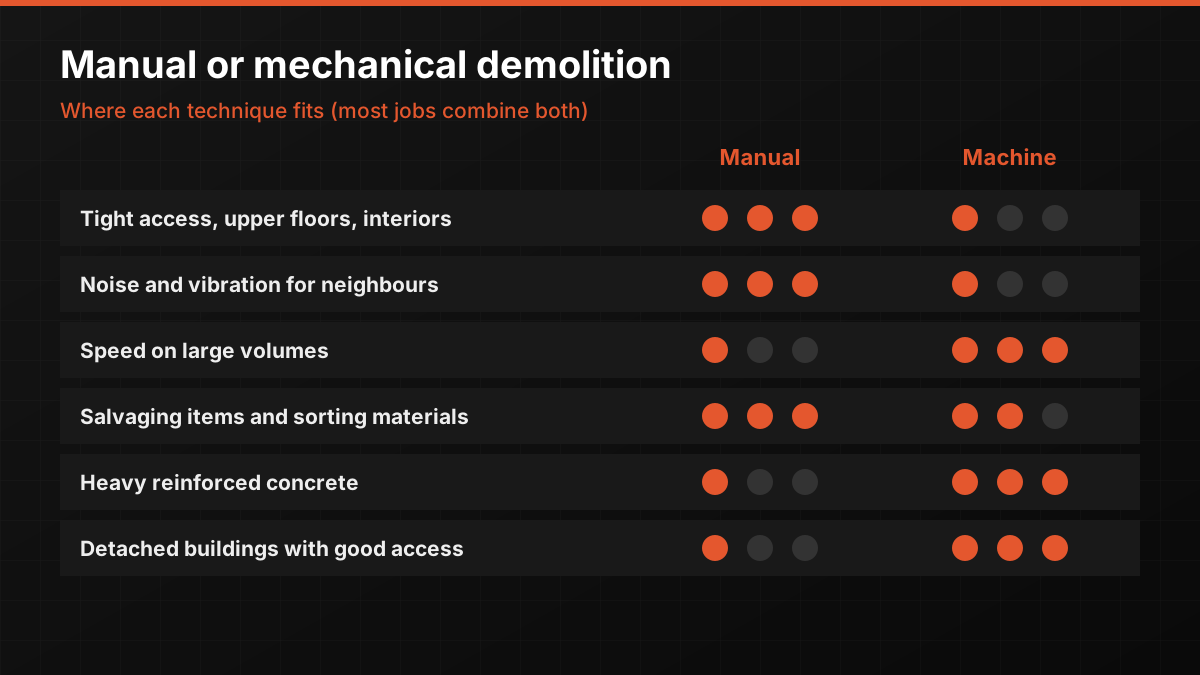
Machines are less suitable inside buildings that stay, on upper floors that cannot carry their weight, at party walls with occupied neighbours and in places they cannot reach. In those cases the work is done by hand or with small equipment, and the machine takes over once the remaining structure is free.
A typical combined job is a commercial building in a terrace: the shared wall is separated by hand, the roof is cut along the boundary, and then the machine demolishes the rest. For interiors and hand work, Demolición Interior Málaga covers interior demolition; for whole industrial buildings, see our warehouse and industrial demolition page, and for dust and vibration around machine work, the dust and vibration control guide.
Frequently asked questions
What is the difference between mechanical and manual demolition?
Mechanical demolition uses excavators with hydraulic attachments; manual demolition uses hand tools and small equipment. Many jobs combine both.
What is top-down demolition?
Demolishing a building from the highest storey downwards, so each level comes off while the one below still supports it and debris falls inwards.
Do I need high-reach demolition for my building?
Only if the structure is taller than a standard machine can safely reach from stable ground. Many medium-height buildings are done with a standard excavator.
Can an excavator demolish a building next to my neighbour's house?
Yes, with a sequence that separates the boundary first, often by hand, and keeps debris falling away from the neighbour.
Can you remove an asbestos roof with the excavator?
No. Asbestos roofing is removed intact beforehand by a RERA-registered company, our subcontractor, under its approved work plan.
What does CDW mean?
Construction and demolition waste: the concrete, masonry, steel, wood and other materials produced by the works, which must be sorted and delivered to authorised facilities.
Do you rent out machines?
No. Machines are used only on the demolitions we carry out.
How is dust controlled during machine demolition?
With water spray or mist at the attachment, wetting of rubble and loads, and pausing in strong wind towards neighbours.
Is selective demolition required with machines too?
Yes. Selective demolition has been mandatory since 1 January 2024 under Ley 7/2022, whatever the method.
What attachment is used for steel structures?
Demolition shears, which cut beams, columns and purlins so they can be lowered and separated as steel.