In short
In Andalusia, town halls require a fianza or guarantee for construction and demolition waste under the regional waste framework (Ley 3/2023 and Decreto 73/2012 as amended). The amount is set by each municipal ordinance, and the deposit is returned once the owner proves that the waste was delivered to an authorised manager – which is why the delivery receipts matter.

Contents
- What is the waste deposit (fianza de residuos)?
- What is the legal basis in Andalusia?
- When does a demolition need a waste deposit?
- Who lodges the deposit and who gets it back?
- How is the amount worked out?
- What do you need to get the deposit back?
- Why refunds stall: the usual mistakes
- What if the job changes once demolition starts?
- Waste deposit checklist before the first machine arrives
- Frequently asked questions
What is the waste deposit (fianza de residuos)?
The fianza de residuos is a refundable deposit or financial guarantee that an Andalusian town hall asks for in connection with works that generate construction and demolition waste. Its purpose is simple: the municipality holds money until the person behind the works proves that the rubble was delivered to an authorised waste manager rather than dumped. Once that proof is accepted, the deposit is returned.
It is not a tax and not a fee for a service. Licence fees and the construction tax are separate charges with their own rules. The fianza is a guarantee that comes back to you – the amount you lodge depends on the municipality, and what you need to recover it is documentation.
What is the legal basis in Andalusia?
Two layers of law sit behind the deposit. At state level, Ley 7/2022 on waste and contaminated soils and Real Decreto 105/2008 on construction and demolition waste define the producer's and possessor's duties. At regional level, Andalusia has Ley 3/2023, de 30 de marzo, de Economía Circular de Andalucía, in force, and the regional waste regulation, Decreto 73/2012, which still applies as amended. Within that framework, town halls require a fianza or guarantee for C&D waste and regulate it through their own ordinances.
We have seen the deposit in the ordinances or forms of Mijas, Vélez-Málaga and Rincón de la Victoria. Each municipality writes its own rules on amount, form of payment and refund procedure, so the details for your town are a matter for its ordinance – your técnico or the ayuntamiento can confirm them (to be verified for each municipality).
When does a demolition need a waste deposit?
As a working rule, assume a deposit will be asked for whenever a job produces construction and demolition waste and goes through the municipal works procedure. For demolitions in Andalusia, that procedure is usually a declaración responsable – the route for total or partial demolition of buildings that are not protected and not in a protected setting, since Decreto-ley 3/2024 – or a licencia urbanística for protected buildings, protected settings and archaeological zones.
Typical jobs on this site that usually involve the deposit:
- Demolition of a warehouse, workshop or farm building – see warehouse and industrial demolition.
- Lifting a concrete yard, a driveway or old foundations – see slabs and foundations.
- Demolition of a house or outbuilding on a plot that will be rebuilt.
Small domestic repair waste is treated as household waste and is usually handled through municipal collection, not through a works deposit. Whether a particular small job needs one is something to check with the town hall before you start.
Who lodges the deposit and who gets it back?
The deposit is tied to the works procedure, so it is normally lodged by the person who promotes the works – the owner or developer who files the declaración responsable or applies for the licence. That is the same party that the waste law treats as the producer. The refund goes back through the same file.
The contractor's role is to make the refund possible. As possessor of the waste, the contractor sorts it, delivers it to authorised managers and passes the delivery receipts to the owner. We do not file municipal procedures or lodge deposits on our clients' behalf; we hand over the receipts load by load so your técnico can assemble the closing documentation.
How is the amount worked out?
Each ordinance sets its own method. Whatever the method, the figures in the file should be consistent with the estudio de gestión de residuos that the técnico prepares for the project. That is one more reason to commission a realistic waste study: an estimate that ignores a concrete slab or a mezzanine floor does not reflect the job that will actually happen, and the closing paperwork will not match it either.
When you budget the job, treat the fianza as cash that is tied up for the duration of the works, not as a cost that disappears. The network's price site explains how this sits alongside other charges in its guide to waste management costs and deposits.
What do you need to get the deposit back?
The refund depends on proving that the waste reached an authorised manager. In practice the file is built from:
- Delivery receipts (justificantes de entrega) or certificates from the authorised facilities, one per load or a summary per fraction, showing the waste code, quantity and origin.
- Consistency with the waste study. What was delivered should be in line with what was declared.
- The municipal refund request on the form or route the ordinance specifies, filed by the owner or their técnico.
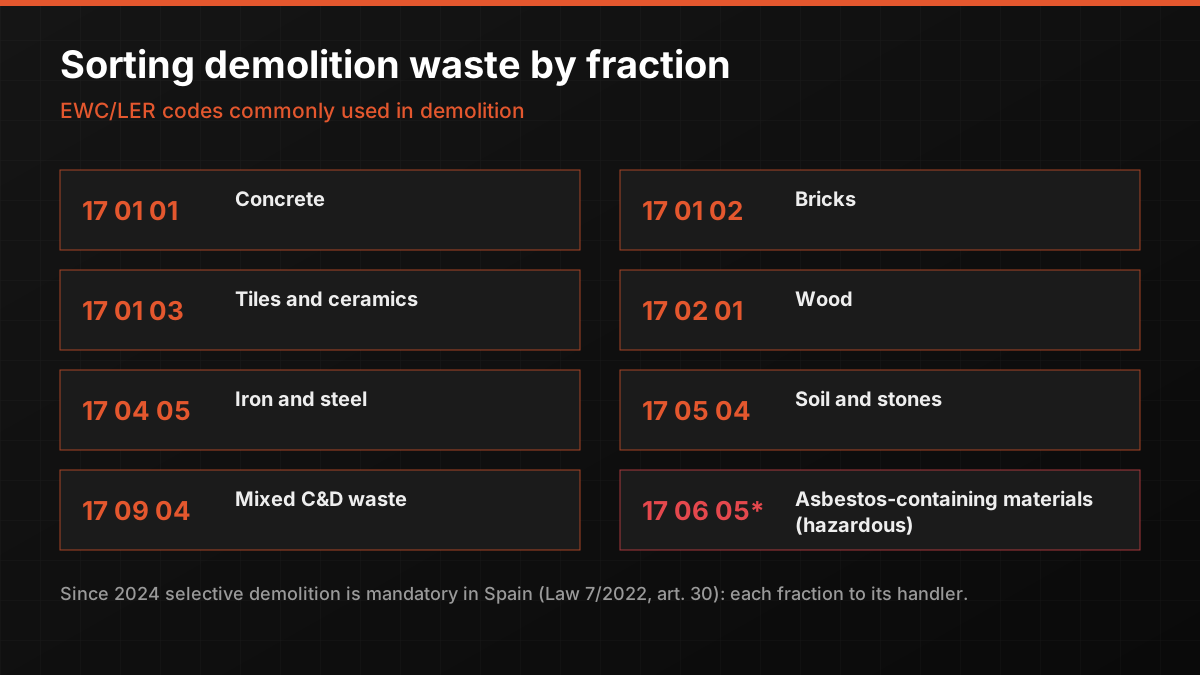
Our guide to EWC/LER codes explains how to check that each receipt carries the right code. Keeping that paperwork tidy is part of how we run rubble removal and skips: every load leaves for an authorised facility and the receipt comes back to the client.
Why refunds stall: the usual mistakes
Most delays come from the end of the job, when nobody is thinking about the deposit any more. The recurring problems are:
- Missing receipts. A load collected by a third party, or taken by a neighbour who wanted fill, leaves no proof.
- Mixed waste where the study promised fractions. If everything left as 17 09 04, the file looks inconsistent with a study that declared clean concrete and steel.
- Receipts that do not identify the site. A receipt without the origin cannot easily be tied to your works.
- Quantities that do not add up. Far less waste delivered than declared invites the question of where the rest went.
- Asbestos handled informally. Fibre-cement waste has to go through a RERA-registered company and its own documentation; the sister site Retirada de Uralita Málaga explains asbestos waste disposal.
Every one of these is avoidable if the receipts are collected while the job is running. If you manage the works from abroad, ask for them as each load leaves; we can also send photo updates of the stockpiles so you can see the sorting.
What if the job changes once demolition starts?
Buildings hide things. A warehouse floor turns out to have a second slab underneath, an old fuel pit appears under the yard, or a roof that looked like metal sheeting proves to be fibre cement once a sample is taken. Each surprise changes the type and amount of waste, and therefore the match between the waste study and the receipts that will close the file.
When that happens, the sensible order is:
- Stop and document. We photograph the find and tell the owner and the técnico before the material is moved or mixed with anything else.
- Let the técnico assess it. The técnico decides whether the waste documentation or the plan de gestión needs updating, and whether anything must be reported to the town hall under its ordinance.
- Route the new fraction properly. Extra concrete goes with the concrete; suspected asbestos waits for the RERA-registered company; anything unusual waits until its destination is clear.
Handled this way, an unexpected slab or pit is an extra line in the paperwork rather than a reason for the town hall to question the whole file at the refund stage. Handled informally – broken up and thrown into the general skip – it becomes exactly the inconsistency that delays a deposit.
Waste deposit checklist before the first machine arrives
Before demolition day, make sure you can answer these questions:
- Has your técnico confirmed which procedure applies – declaración responsable or licence – and whether the ordinance asks for a waste deposit?
- Does the estudio de gestión de residuos reflect the real building, including slabs, foundations and any fibre-cement roof?
- Is the contractor's plan de gestión ready for the dirección facultativa to approve?
- If skips or lorries will stand on the street, has the public road occupation been authorised?
- Who will collect and keep the delivery receipts, and in what format will you receive them?
For an indicative price range for the demolition itself, use the calculator on Presupuesto Demolición. For a quote on your building in Málaga province, send us photos, the address and the approximate size.
Sources
Frequently asked questions
Is the waste deposit a tax?
No. It is a refundable deposit or guarantee that ensures construction and demolition waste goes to an authorised manager; it is returned when that is proven.
How much is the fianza for demolition waste?
It depends on each municipal ordinance and on the job. We do not publish amounts; your técnico or the town hall can tell you how your municipality calculates it.
Which law supports the waste deposit in Andalusia?
The regional framework of Ley 3/2023 de Economía Circular de Andalucía and Decreto 73/2012 as amended, alongside Ley 7/2022 and RD 105/2008 at state level. Each town hall regulates the detail in its ordinance.
Do all Málaga municipalities ask for it?
We have confirmed it in the ordinances or forms of Mijas, Vélez-Málaga and Rincón de la Victoria. For other municipalities check the local ordinance (to be verified).
Who pays the deposit, the owner or the contractor?
It is normally lodged by the person who promotes the works and files the municipal procedure, usually the owner. The contractor supplies the receipts needed for the refund.
What proves that waste was handled correctly?
Delivery receipts or certificates from authorised waste managers, showing the waste code, quantity and origin of each load.
Can I get the deposit back if some rubble was used as fill on my plot?
Material that did not go to an authorised manager has no delivery receipt. Any reuse on site should be planned in the waste documentation with your técnico beforehand, not decided at the end.
Does the deposit apply to small bathroom works?
Waste from minor repair works in a private home counts as household waste. Whether a small job needs a works deposit is set by the municipal procedure, so ask the town hall.
Does an asbestos roof change the deposit paperwork?
Asbestos waste travels under its own code (17 06 05*) and its own documentation from the RERA-registered company. Keep those papers with the rest of the receipts.
Do you lodge the deposit for me?
No. We do not file municipal procedures; the owner and their técnico do. We deliver the waste to authorised facilities and give you the receipts.
How long does the refund take?
That depends on the town hall and on how complete your file is. Complete, consistent receipts are the factor you control.