In short
In Spain, construction and demolition waste is the responsibility of the producer (in practice the promotor who commissions the works), the possessor (the contractor who handles it on site) and the authorised waste manager who receives it. Since 2022 the waste must be sorted by fraction, selective demolition has been compulsory since 1 January 2024, and asbestos always travels separately.

Contents
- Who is responsible for demolition waste in Spain, in one paragraph?
- What does Spanish waste law actually require on a demolition site?
- The producer: what falls on the owner who commissions the demolition?
- The possessor: what the demolition contractor has to do with the rubble
- The authorised manager: where responsibility for the waste ends
- Where the town hall fits in
- Asbestos and other hazardous waste: a separate track
- Small domestic jobs versus real demolition
- Checklist for owners who manage the job remotely
- Frequently asked questions
Who is responsible for demolition waste in Spain, in one paragraph?
Responsibility for demolition rubble in Spain is shared out along a chain. The producer is the party behind the works – normally the owner or developer (promotor) who commissions the demolition and whose project includes the waste study. The possessor (poseedor) is whoever physically holds the waste while it is on site, which on a demolition job means the contractor. The authorised manager (gestor autorizado) is the licensed facility that receives the waste and recycles, treats or disposes of it. Each link has its own paperwork, and each one depends on the previous link having done its part properly.
This matters to you as an owner because the chain starts with you. Even when you hire a contractor for everything, the project you submit to the town hall carries your name, and any deposit lodged for the waste is normally refunded to the person who promoted the works once delivery to an authorised facility is proven.
| Role | Who it usually is | Key document |
|---|---|---|
| Producer (productor) | Owner or developer commissioning the works | Estudio de gestión de residuos inside the project, drafted by the técnico |
| Possessor (poseedor) | Demolition contractor | Plan de gestión de residuos, approved by the dirección facultativa |
| Authorised manager (gestor) | Licensed recycling or treatment facility | Delivery receipts (justificantes de entrega) for each load |
What does Spanish waste law actually require on a demolition site?
The reference law is Ley 7/2022, de 8 de abril, de residuos y suelos contaminados para una economía circular. Its article 30 is the one that changed day-to-day practice on demolition sites, and it contains three rules worth knowing by heart.
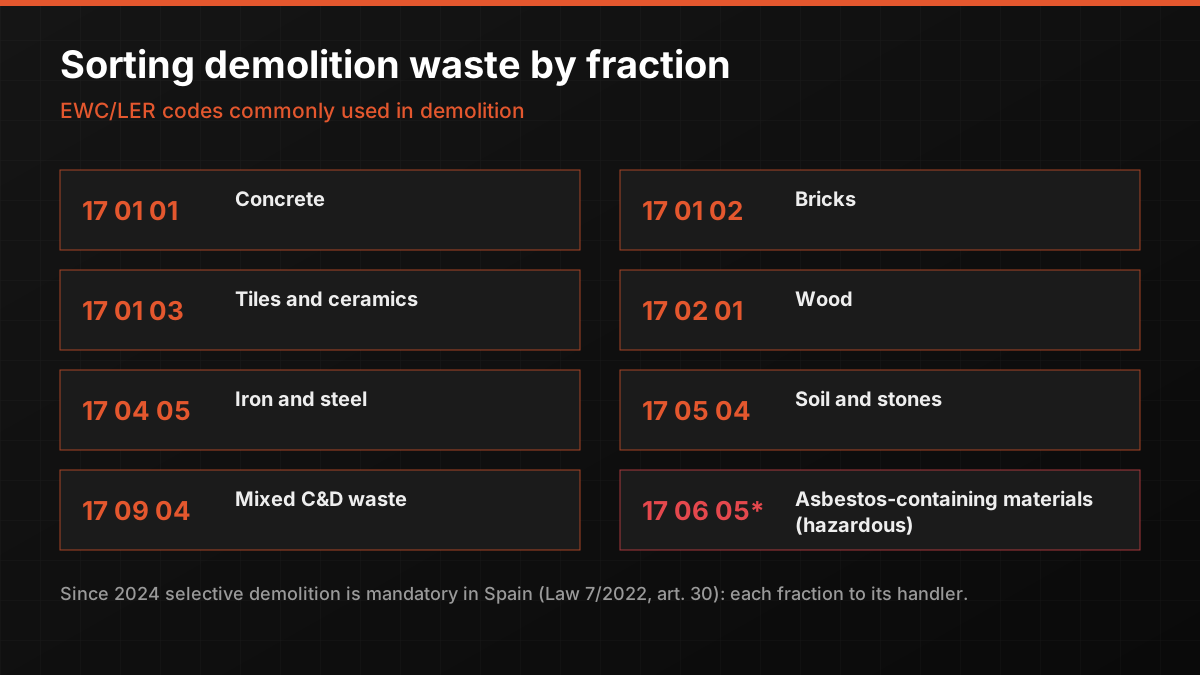
- Sorting by fraction. Since 1 July 2022, non-hazardous construction and demolition waste has to be separated at least into wood, mineral fractions (concrete, bricks, tiles, ceramics and stone), metals, glass, plastic and plaster or gypsum. Elements that can be reused must be set aside before they become waste.
- Selective demolition. Demolition was first encouraged to be selective; since 1 January 2024 selective demolition is compulsory. In plain terms, a building is taken apart in an order that keeps the fractions clean instead of being knocked down into one mixed heap.
- Hazardous materials apart. Hazardous substances, and asbestos in particular, must be handled safely and never mixed with other waste.
The older Real Decreto 105/2008, which regulates the production and management of construction and demolition waste, still sets out the documents: the estudio de gestión de residuos in the project and the contractor's plan de gestión. Its old tonnage thresholds for sorting were overtaken by the 2022 law, so a job today is sorted regardless of size. For the demolition side of the same rule, the pillar site of our network explains why selective demolition is now mandatory and how it changes the order of work.
The producer: what falls on the owner who commissions the demolition?
As producer, your duties are mostly front-loaded. The project or technical report for the demolition – drafted and signed by a técnico competente – has to include an estudio de gestión de residuos (RD 105/2008, art. 4). That study estimates what the building will produce, how it will be separated and where each fraction is expected to go. It is not a formality: it travels with the documentation filed with the town hall, and the delivery receipts at the end of the job will be read against it.
Three practical points follow from this role:
- Commission a realistic study. A warehouse with a fibre-cement roof, office partitions in plasterboard and a thick concrete slab produces a very different mix from a brick farm building. Give your técnico access to the whole site, including mezzanines, plant rooms and the roof.
- Choose a contractor who can follow it. If the study says concrete and steel will be separated and recycled, the contractor needs the method and the space to do so. Ask how they will sort, where skips or stockpiles will stand and who receives each fraction.
- Keep the proof. The delivery receipts from the authorised facilities are what close your file. Store them with the project, not in an email you may lose.
We work with the project and documentation your técnico prepares; we do not draft the estudio de gestión ourselves, but we tell your técnico early which fractions and volumes we expect to see once the building is opened up.
The possessor: what the demolition contractor has to do with the rubble
From the day the first wall comes down until the last lorry leaves, the waste is in the contractor's hands. Under RD 105/2008 the contractor prepares a plan de gestión de residuos that turns the producer's study into an execution method, and that plan is approved by the dirección facultativa before work begins. On site, the possessor's job is to keep the fractions separate, store them safely and hand them to authorised managers – never to an informal tip.
On our jobs this is how the waste side is organised:
- Soft strip first: wood, plastics, glass, insulation and gypsum-based boards come out before the structure is touched, so they never end up inside the concrete heap.
- Mechanical sorting on the ground with the excavator's grapple, separating brick and concrete from steel sections, rebar and timber.
- Metals stockpiled apart; concrete either loaded out to a recycling facility or, where the job justifies it, processed with a mobile crusher – see our crushing and recycling service.
- Loads leave in skips or lorries to an authorised facility, and the client receives the delivery receipts for each one. Details on containers and loading are on our rubble removal and skips page.
The possessor cannot legally pass mixed waste off as sorted. If the fractions get contaminated – plasterboard dust through a concrete pile, for instance – the load may be refused at the facility or reclassified as mixed waste, which changes how it is treated and how it looks on your paperwork.
The authorised manager: where responsibility for the waste ends
The chain closes at the gestor autorizado, a facility authorised by the regional environmental administration to recycle, treat or dispose of specific waste types. Concrete and masonry typically go to a recycling plant that produces aggregates; steel goes to a metal recycler; mixed waste goes to a facility able to sort it further. Each delivery generates a receipt that identifies the waste by its code, the quantity, the origin and the date.
Those receipts are the only objective evidence that the waste left your site through the legal route. Our guide to EWC/LER codes for demolition waste explains how to read the codes printed on them, and the guide on waste deposits in Andalusia covers the step where those same receipts get your deposit back.
Where the town hall fits in
The ayuntamiento is not part of the waste chain itself, but it controls the gate through which the job starts. In Andalusia, the total or partial demolition of a building that is not protected and not inside a protected setting is processed by declaración responsable (RGLISTA art. 293.1.e, as amended by Decreto-ley 3/2024); protected buildings, protected settings and archaeological zones still need a licencia urbanística. Before 2024 the general rule was a licence. Either way, the waste study travels with the documentation.
Andalusia also has its own framework: Ley 3/2023, de 30 de marzo, de Economía Circular de Andalucía is in force and Decreto 73/2012 (the regional waste regulation) still applies as amended. Under that framework town halls ask for a fianza or guarantee for construction and demolition waste, set by each municipal ordinance and returned once delivery to an authorised manager is proven.
A further point that catches owners out: a skip or a lorry parked on the street needs a public road occupation permit. Before starting, it is checked with the ayuntamiento which procedure applies (declaración responsable or licence) and whether the container or scaffolding needs street-occupation authorisation. The owner and their técnico handle those filings; we coordinate dates around them.
Asbestos and other hazardous waste: a separate track
Fibre-cement roofs, downpipes and water tanks are still common on older warehouses and farm buildings in the province of Málaga. Asbestos-containing materials are hazardous waste – code 17 06 05* – and Ley 7/2022 forbids mixing them with anything else. Since late October 2026 the work itself is governed by Real Decreto 847/2026, which replaced RD 396/2006: only companies registered in the RERA may remove asbestos materials, under a work plan approved by the provincial labour authority.
We are not RERA-registered. The asbestos removal is carried out by a RERA-registered company working as our subcontractor; that company prepares and files its own plan de trabajo and removes the material, and we coordinate the rest of the demolition around it. The asbestos waste is packed and delivered separately to an authorised manager, never added to the rubble. If your building has a fibre-cement roof, the sister site Retirada de Uralita Málaga explains asbestos in warehouses in more depth.
Small domestic jobs versus real demolition
Not every pile of broken tiles is construction and demolition waste in the legal sense. Waste from minor repair works in a private home is treated as household waste, which is why town halls run clean points and collection services for small DIY quantities. A warehouse, a barn, a concrete yard or a whole house is a different matter: that is a construction or demolition job with a producer, a possessor and a manager.
If you are unsure which side of the line your project falls on, ask the ayuntamiento or your técnico before you start. Calling a large job minor to skip the paperwork tends to unravel as soon as a skip appears on the street.
Checklist for owners who manage the job remotely
Many of the owners we work with on the Costa del Sol live abroad for part of the year. The waste side of a demolition can be followed from a distance if you insist on a few things in writing:
- A copy of the estudio de gestión de residuos from your técnico, so you know what fractions were declared.
- The contractor's plan de gestión, and confirmation that the dirección facultativa approved it.
- A short written description of how sorting will happen on site and where each fraction goes – by type of facility.
- Delivery receipts sent to you as the loads leave, not in a bundle months later. We can send photo updates of the stockpiles while the job is running, and you can write to us in English.
- A separate record for any asbestos removal, issued by the RERA-registered company.
Waste handling also shapes the price: the fractions, the volume and the distance to facilities are all cost factors. For an indicative range, use the demolition calculator on Presupuesto Demolición; for a quote for your site, send us photos and the address.
Sources
Frequently asked questions
Who is the producer of demolition waste in Spain?
In practice the producer is the promotor of the works, usually the owner who commissions the demolition. The producer's project includes the estudio de gestión de residuos drafted by the técnico.
Is the demolition contractor responsible for the rubble?
Yes, while the waste is on site. As possessor, the contractor prepares the plan de gestión de residuos, keeps the fractions separate and delivers them to authorised managers.
What is a gestor autorizado?
An authorised waste manager: a facility licensed to recycle, treat or dispose of particular waste types. Its delivery receipt is the proof that a load left your site legally.
Since when must demolition waste be sorted in Spain?
Since 1 July 2022 non-hazardous construction and demolition waste must be separated at least into wood, mineral fractions, metals, glass, plastic and plaster, under article 30.2 of Ley 7/2022.
Is selective demolition compulsory?
Yes. Article 30.3 of Ley 7/2022 has made selective demolition mandatory since 1 January 2024, so buildings are dismantled in an order that keeps materials separate.
Who writes the estudio de gestión de residuos?
A técnico competente, as part of the project or technical report for the demolition. We do not draft it; we work with the documentation your técnico prepares.
What happens if rubble is dumped illegally?
Waste that does not reach an authorised manager has left the legal chain, and the responsibility can come back to the producer. Always ask where each load goes and keep the delivery receipts.
Can asbestos go in the same skip as the rubble?
No. Asbestos waste is hazardous (17 06 05*) and may never be mixed with other waste. It is removed by a RERA-registered company and delivered separately.
Does broken tile from a small bathroom repair count as demolition waste?
Waste from minor repair works in a private home counts as household waste. A demolition of a building, yard or slab is construction and demolition waste with its own paperwork.
Which papers should I keep after the job?
The estudio de gestión, the approved plan de gestión, every delivery receipt and, if there was asbestos, the records of the RERA-registered company. They are what you need to close the municipal file and recover any waste deposit.
Do I need a permit to dispose of rubble in Spain?
The waste itself goes through authorised managers, not through a personal permit. What usually needs permission is the works procedure at the town hall and, if a skip stands on the street, the public road occupation.