In short
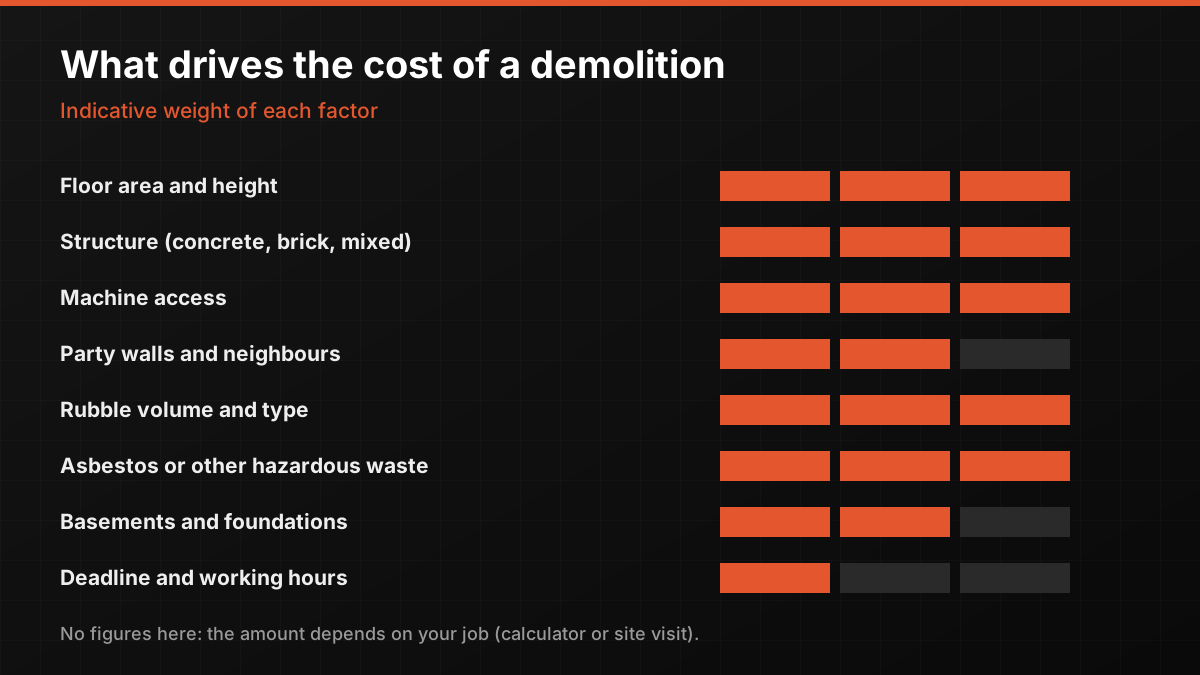
The cost of demolishing a warehouse is driven mainly by the structure (steel frame, precast or cast-in-place concrete), the roof and cladding materials, whatever is still inside, how much of the slab and foundations must go, and how the sorted rubble is handled and transported. Access, neighbours and deadlines adjust the figure further. For an indicative band, use the calculator on our sister site presupuestodemolicion.eu.

Contents
- What actually decides the cost of demolishing a warehouse?
- How does the structure of the building change the job?
- Why the roof can change the quote more than anything else
- Does it matter what is still inside the warehouse?
- Slab, foundations and what lies below ground
- How waste sorting and transport shape the final figure
- Access, neighbours, paperwork and timing
- How to get a realistic estimate for your warehouse
- Frequently asked questions
What actually decides the cost of demolishing a warehouse?
A warehouse demolition is priced on the work it takes to dismantle the building safely, separate what comes out of it and take every fraction to the right place. Floor area is a starting point, but it hides most of the variables. A light steel shed on an open plot and a block-walled nave with a concrete mezzanine, a pit and an old fibre-cement roof are two different jobs even if both measure the same.
When we prepare a quote for warehouse and industrial demolition, these are the questions that move the figure most:
| Factor | Why it changes the work |
|---|---|
| Structural system | Steel frames are cut and lowered; concrete frames are crushed or broken and produce far more heavy rubble. |
| Roof and cladding | Sandwich panel, metal sheet and fibre-cement sheeting each follow a different removal and waste route. |
| Contents left inside | Racking, machinery, tanks or stock slow the strip-out and may need separate handling. |
| Below ground | Keeping the slab, breaking it out, or digging out footings and pits are three very different scopes. |
| Waste and transport | Volume of each fraction, how cleanly it can be sorted and the distance to authorised facilities. |
| Site conditions | Access for machines and lorries, adjoining buildings, working hours and the deadline. |
How does the structure of the building change the job?
The frame tells us which machine and which sequence the job needs. A steel portal frame is usually dismantled by cutting purlins, bracing and columns in a controlled order, lowering members with the excavator and sorting the steel as it comes down. It is relatively quick and leaves little mineral rubble above slab level.
Reinforced concrete is a different story. Cast-in-place columns, beams and floors have to be crushed or broken with hydraulic attachments, the rebar separated and the concrete loaded as a heavy fraction. Precast frames sit somewhere in between: beams and columns can sometimes be separated at the joints, but the elements are large and heavy. Block or brick infill walls add volume to the mineral fraction. Height matters as well: anything beyond the comfortable reach of a standard excavator calls for a long-reach machine or a different sequence, which we explain in our guide to excavators, shears, breakers and high reach.
Inside the frame, mezzanines, offices built within the nave, crane runway beams and loading docks all add their own steps. A plain single-volume shed is the simplest case; every addition built over the years is another item on the list.
Why the roof can change the quote more than anything else
The roof is often the single item that reshapes a warehouse quote. Metal sheeting and sandwich panels are dismantled and sorted as metal and, where panels have an insulating core, as a separate fraction. Translucent rooflights are fragile and are a fall-through hazard during dismantling, so access and protection have to be planned around them.
Older naves in the provincia de Málaga frequently have fibre-cement sheeting, the material known in Spain as uralita, which may contain asbestos. That part of the work follows its own legal route. The asbestos removal is carried out by a company registered in the RERA working as our subcontractor, under its own work plan approved by the labour authority, and the material leaves the site as hazardous waste, never mixed with the rest. We coordinate the rest of the demolition around it. Our sister site explains asbestos removal from warehouses in detail. For cost purposes, what you need to know is that a fibre-cement roof adds a separate phase, separate waste handling and its own timing, and must be identified before any machine touches the building.
Does it matter what is still inside the warehouse?
Yes, and owners often underestimate it. A building handed over empty and swept is a straightforward strip-out followed by the structural demolition. A building with pallet racking, abandoned machinery, office furniture, cables, stock or old vehicles inside needs extra time before the structure can be touched, because every item has to be removed and separated.
Some contents need particular care. Tanks, oil sumps, compressors, refrigeration units and drums have to be emptied and cleaned by the owner or a specialised company before the demolition team handles them. Chemical residues, used oils or fluids are not demolition waste and are not something we take away with the rubble. Telling us early what is inside, ideally with photos of every bay and room, avoids a quote built on assumptions.
Slab, foundations and what lies below ground
What happens below floor level is the second big variable. If the new project reuses the plot as hardstanding, the slab may stay and only the superstructure comes down. If a new building with a different layout is planned, the slab, ground beams and footings usually have to be broken out and removed, which can produce more concrete than the building above it.
Inspection pits, buried tanks, drainage channels, machine bases and old foundations from earlier buildings are common in industrial plots and are not always on any drawing. Breaking out a thick reinforced slab with a hydraulic breaker is a different rhythm of work from removing a thin unreinforced floor. Our page on slab and foundation removal explains the options; for the quote, the key is to agree in writing how deep the removal goes and what happens if something unexpected appears.
How waste sorting and transport shape the final figure
Since July 2022, Spanish waste law requires construction and demolition waste to be sorted at least into wood, mineral fractions, metals, glass, plastic and plaster, and selective demolition has been compulsory since 1 January 2024. On a warehouse job that means the building is taken apart in an order that keeps those fractions clean, and each one goes to an authorised facility with its delivery receipts.
The cost effect comes from three things: how many tonnes of each fraction the building produces, how cleanly they can be separated, and how far the lorries travel. Clean concrete is easier to recycle than mixed rubble. Where the volume of concrete and masonry is large and the plot has space, crushing on site can change the transport equation, as we discuss in is on-site crushing worth it?. Loading and haulage are organised through our rubble removal and skips service, or by direct loading onto lorries with the excavator on larger jobs.
Access, neighbours, paperwork and timing
The last group of factors is about the site itself. A nave on an industrial estate with a wide yard lets machines and lorries move freely. A warehouse squeezed between other units, or with a party wall shared with a building that stays, needs a slower sequence, more protection and sometimes manual work along the shared wall. Dust control with water spray, working hours and a tight deadline all have an effect on how the job is organised.
Paperwork affects timing rather than the demolition itself. In Andalusia, total or partial demolition of buildings that are not protected is generally done by declaración responsable filed with the town hall by the owner and their técnico; protected buildings still need a licence. We work with the documentation your técnico prepares and coordinate dates with them; we do not file it. If a skip or a machine has to stand on the public road, that needs municipal authorisation before the start date.
How to get a realistic estimate for your warehouse
Because public price lists would be misleading for a job with this many variables, we do not publish figures here. Our sister site has a demolition cost calculator that gives a rounded indicative band, and a no-obligation written quote follows once we have the details. To make either of them meaningful, send us:
- the address or municipality and photos of the outside, the roof and every interior bay;
- approximate dimensions and height, and the type of frame if you know it;
- what the roof is made of, or a close-up photo of the sheeting;
- whether the slab and foundations stay or go;
- what will still be inside on the start date, and your target dates.
You can write to us in English at oficina@derribosindustrialesmalaga.eu or on WhatsApp. If you are still deciding whether the building should come down at all, our post on alternatives to full demolition is a good next read, and the machine demolition page explains how the work itself is done.
Sources
Frequently asked questions
Can you give me a price per square metre for a warehouse?
We do not publish per-square-metre prices because the frame, roof, contents and slab change the work too much. The calculator on presupuestodemolicion.eu gives a rounded band, and a written quote follows once we know the building.
Is a steel warehouse cheaper to demolish than a concrete one?
Usually the work is lighter, because a steel frame is cut and lowered and produces little mineral rubble. A concrete frame needs crushing or breaking and generates heavy rubble to sort and transport.
Does an asbestos roof make the demolition more expensive?
It adds a separate phase carried out by a RERA-registered company working as our subcontractor, with its own work plan and hazardous waste route. It is quoted as its own item.
Who has to empty the warehouse before demolition?
Stock, chemicals, oils and the contents of tanks are the owner's responsibility and must be removed or cleaned by the owner or a specialised company. Racking, furniture and general contents can be included in the strip-out if agreed in the quote.
Is breaking out the slab included in a warehouse demolition?
Only if the scope says so. Many quotes cover the building down to slab level; removing the slab, ground beams and footings is a separate item that must be stated in writing.
Why does the distance to the recycling facility matter?
Every fraction travels by lorry to an authorised facility, so the number of loads and the distance affect transport time. Clean, well-sorted fractions also tend to be easier for the facility to accept.
Can on-site crushing reduce the cost?
On large jobs with a lot of clean concrete and space on the plot, it can reduce the number of lorry loads. On small or cramped sites the cost of bringing the crusher usually outweighs the saving.
Do I need a permit before you can price the job?
No, we can quote first. The declaración responsable or licence is handled by you and your técnico before the start, and we work with that documentation.
Is VAT included in the calculator result?
No, the calculator shows figures without VAT. Demolition is generally taxed at the standard rate, and each quote states the rate that applies.
What information gives the most accurate quote?
Photos of every part of the building including the roof, the dimensions, the frame type, what stays below ground and what will still be inside on the start date.
Can you visit a warehouse if I live abroad?
Yes. You can arrange access through a representative or key holder, and we keep you informed in English by email or WhatsApp.