In short
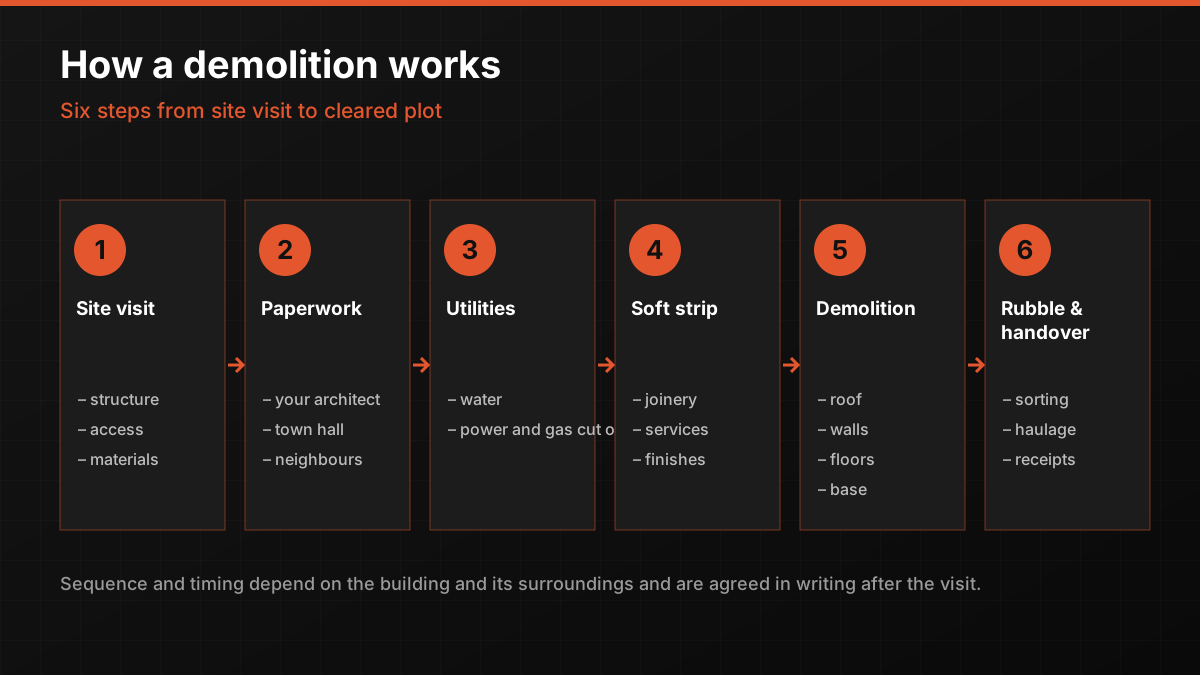
A machine demolition with us runs in six stages: first contact with photos, a site visit and written quote, preparation with your técnico's documentation and the building emptied and disconnected, any asbestos removal by a RERA-registered subcontractor, the mechanical demolition with sorting and dust control, and the final clean-up with delivery receipts. You can follow it in English with regular photo updates.

Contents
- Stage 1: first contact and the photos we ask for
- Stage 2: site visit and a written quote
- Stage 3: preparation before any machine arrives
- Stage 4: the demolition sequence
- Stage 5: sorting, loading and the slab
- Stage 6: handover, and where things can get messy
- Following the job from abroad
- Frequently asked questions
Stage 1: first contact and the photos we ask for
Most jobs start with a message or a call and a set of photos. We ask for the outside of the building from every side, the roof, the interior of each room or bay, the access from the street and anything that looks unusual: tanks, pits, sheds, old pipework. With the municipality and approximate dimensions, that is enough to tell you whether the job is a typical machine demolition or something that needs a different approach.
At this point we also ask what happens afterwards. A new building, a cleared plot for sale, hardstanding or a pool changes what has to come out of the ground and how the site is left. You can write in English or Spanish, by e-mail at oficina@derribosindustrialesmalaga.eu or on WhatsApp.
Stage 2: site visit and a written quote
Before quoting we visit the site, or arrange access through a key holder if you are not in Spain. We look at the structure, the materials, the neighbours, the space for machines and lorries and anything that could contain asbestos. That visit is where most surprises are found while they are still cheap to deal with.
The written quote states the scope in plain language: what is demolished, down to which level, whether the slab and foundations are included, how the waste is handled and what is excluded. Where the job has open questions, such as what lies under a slab, we write them down instead of guessing. The quote is no-obligation; for a quick indicative band before the visit, there is the calculator on presupuestodemolicion.eu.
Stage 3: preparation before any machine arrives
Preparation is the part clients see least and the part that matters most. Three things have to be in place:
- Documentation. Your técnico prepares the technical documentation, including the safety study, and you file the declaración responsable or licence with the town hall. We work with that documentation, prepare our own health and safety plan and waste management plan, and coordinate dates with your técnico. If a skip or machine needs to stand on the street, the public road authorisation has to be in place.
- An empty, disconnected building. Electricity, water and gas are disconnected by the supply companies, and stock, chemicals, oils and the contents of tanks are removed by the owner or specialised companies.
- Asbestos dealt with first. If there is fibre cement or other asbestos material, it is removed beforehand by a RERA-registered company working as our subcontractor, under its approved work plan. We coordinate the rest of the demolition around it.
Stage 4: the demolition sequence
The building is taken apart in a defined order, not knocked over. Light materials from the interior come out first: doors, windows, timber, plastics, plasterboard, installations. Then the structure comes down from the top, floor by floor or bay by bay, with the excavator working from outside the building's footprint wherever possible. On taller structures that means a long-reach machine working top-down; on single-storey naves, a standard excavator with shears, a grapple or a crusher.
Throughout this stage, water spray keeps dust down at the point where the attachment works, which is what you see in our own photos of concrete frames being crushed. The sequence near neighbouring buildings is slower and, where necessary, combined with manual work along party walls. Our guide on dust and vibration control explains these measures in more detail.
Stage 5: sorting, loading and the slab
Sorting happens as the building comes down. Steel is separated from concrete, wood from masonry, and each fraction goes to its own pile or container. The rubble is loaded onto lorries or into skips through our rubble removal service and delivered to authorised facilities, and each load generates a delivery receipt. Where volumes justify it, concrete can be crushed on site instead.
If the scope includes the ground slab and foundations, they are broken out after the superstructure has gone, with the concrete kept separate from the soil underneath. Our slabs and foundations page explains the options.
Stage 6: handover, and where things can get messy
At the end, the plot is left clear of rubble, with basic levelling where it was agreed, and you receive the delivery receipts for the waste. Those receipts are what you need if the town hall holds a waste deposit or guarantee, which it returns once delivery to an authorised manager is proven.
Being honest about the process also means saying where it gets messy. Buried foundations from older buildings, tanks nobody mentioned, asbestos in places it was not expected, heavy rain that turns a plot to mud, a neighbour's wall that turns out to rest on yours: these things happen. When they do, we stop that part of the work, show you what we found with photos, explain the options and agree the next step in writing before continuing. That is also why our quotes list open questions instead of hiding them.
Following the job from abroad
Many owners of industrial buildings and plots on the Costa del Sol are not in Spain while the work happens. The process is designed for that. We agree a point of contact, communicate in English, and send photo updates at the key moments: start, end of strip-out, end of the structural demolition, slab and final handover. Documents and receipts are sent digitally.
If you want to understand the machines involved before the job starts, our guide to machine demolition explained is the place to go. And if you are comparing contractors, the industrial demolition contractor checklist lists what to ask any of them, including us. For full building demolitions beyond the industrial context, see also our warehouse and industrial demolition page.
Sources
Frequently asked questions
What do you need from me to start?
Photos of the building and the access, the municipality, approximate dimensions and what you plan to do with the plot afterwards.
Do you visit the site before quoting?
Yes, or we arrange access through a key holder if you are abroad. The visit is where we check structure, materials, neighbours and possible asbestos.
Do you get the demolition permit?
No. Your técnico prepares the documentation and you file the declaración responsable or licence with the town hall; we work with it and coordinate dates.
Who disconnects the utilities?
Electricity, water and gas are disconnected by the supply companies at the owner's request before the demolition starts.
What happens if there is asbestos?
A RERA-registered company working as our subcontractor removes it first under its approved work plan, and we coordinate the rest of the demolition.
How do you control dust during the demolition?
With water spray at the point where the attachment works, and a sequence planned around neighbours and wind.
Is the rubble sorted?
Yes. Steel, concrete, masonry, wood and other fractions are separated as the building comes down and delivered to authorised facilities.
What do I receive at the end?
A plot cleared of rubble as agreed in the scope and the delivery receipts for every waste load.
What happens if something unexpected is found?
We stop that part of the work, send photos, explain the options and agree the next step in writing before continuing.
Can I follow the work in English from abroad?
Yes. We communicate in English and send photo updates at the key stages, with documents and receipts sent digitally.