In short
High-reach demolition is for buildings taller than a standard excavator can safely demolish from the ground, for multi-storey structures that must come down top-down in a controlled way, and for tall buildings in tight surroundings. Single-storey warehouses, houses and low outbuildings normally do not need it; a standard excavator or manual work is more suitable.

Contents
What is high-reach demolition, in one paragraph?
High-reach demolition uses an excavator with a long, specially designed demolition boom that carries a crusher, shears or other attachment at a height a standard excavator cannot reach. The machine stays on the ground outside the building and takes the structure apart from the top down, floor by floor, so that material falls inwards and in a controlled way. Our own photos of a long-reach machine working top-down on a four-storey industrial building show exactly this method.
It is one of several tools within machine demolition. Whether it is the right one depends on the height of the building, its structure and its surroundings, not on the size of the plot or the owner's preference.
The reason the method exists is control. Pulling a tall wall or frame over from the ground, or undermining it from below, lets gravity decide where the structure falls. Working from the top means each piece is detached deliberately, at a height where the operator can see it, and dropped into the footprint of the building. The attachments are the same family as on standard machines, crushers for concrete and shears for steel, only mounted on a boom built for height.
Who needs it: buildings above standard reach
The clearest case is height. When the top of the building is beyond the comfortable working height of a standard excavator, demolishing it from the ground would mean pulling or pushing upper parts without control. That is unsafe for the operator, for the site and for anyone nearby. A long-reach machine reaches the top and works downwards.
Typical candidates are:
- multi-storey industrial buildings and old factories;
- reinforced concrete frames of several floors, such as apartment blocks, offices or hotels being cleared;
- tall elements on industrial plots: silos, towers, chimneys and high bays;
- buildings that cannot be approached safely from the inside because of their condition.
Who needs it: top-down demolition in tight surroundings
Height is not the only reason. Top-down demolition is also chosen because it is controlled. When a tall building stands close to neighbours, roads or structures that must stay, taking it apart from the top lets the material fall inside the footprint rather than outwards. The aerial photo of a villa demolition in a dense urban area in our gallery shows how close neighbouring buildings can be.
In these situations, a long-reach machine combined with water spray for dust and a carefully planned sequence is often the safest way to work. Along party walls, the last metres may still be done manually or with smaller machines. Dust and vibration management is covered in our guide on dust and vibration control.
Who does not need it
Most warehouses in the provincia de Málaga are single-storey naves with a steel or precast concrete frame. Their eaves and ridge are well within the reach of a standard demolition excavator, which can cut, crush and lower everything from the ground. Bringing a long-reach machine to such a job adds transport and set-up without any gain in safety or control.
The same applies to most houses, villas, outbuildings, garages, terraces and boundary walls. They are demolished with standard excavators of the right size, often combined with manual work where access is limited. Interior demolition and strip-out, of course, do not need any heavy machine at all. Our warehouse and industrial demolition service will tell you plainly which machine your building needs.
Grey areas: two or three storeys and mixed buildings
Between the obvious cases there is a middle ground: two- or three-storey buildings, industrial units with an office block on top, or a low nave with one tall element. Here the choice depends on details such as the exact height, the structure (a concrete frame behaves differently from load-bearing masonry), the space around the building for the machine to stand and the distance to neighbours.
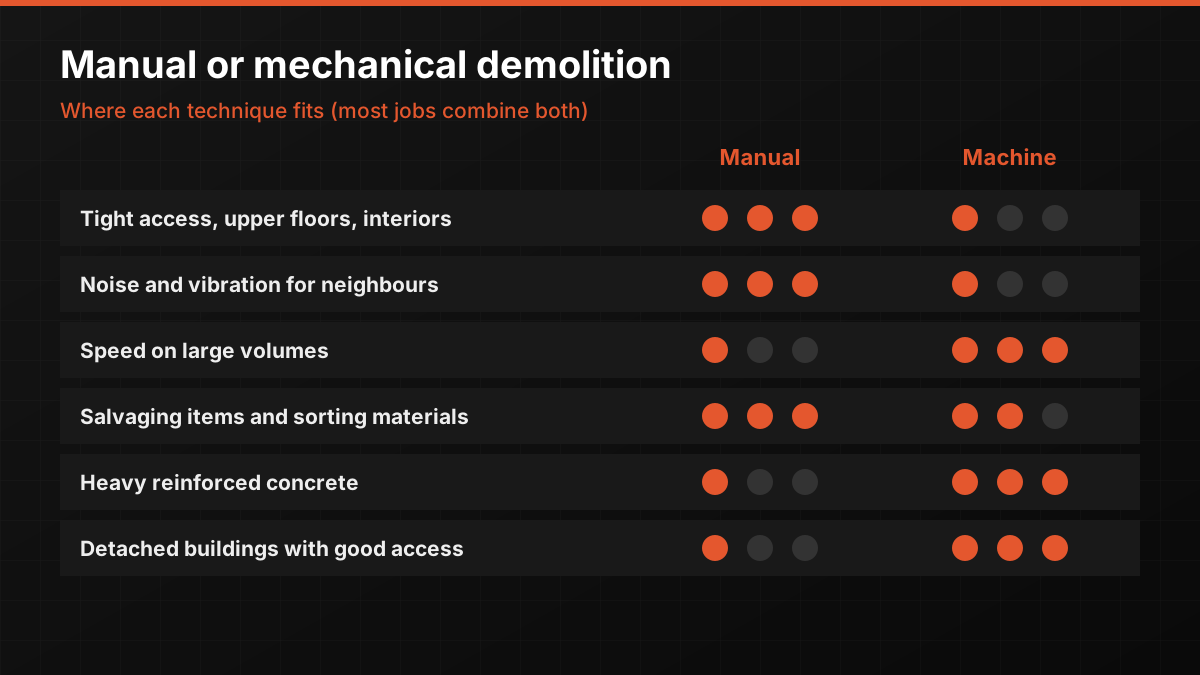
Sometimes the answer is a combination: a long-reach machine for the tall part and a standard excavator for the rest, or a standard machine with an extended arm working from a ramp of rubble. In some cases, manual demolition of the top floor before the machine starts is the most sensible approach; our sister site on hand demolition explains when that applies. For reinforced concrete specifically, see our page on concrete demolition.
Quick self-check
| Your building | Long reach usually needed? |
|---|---|
| Single-storey warehouse or nave | No; standard demolition excavator |
| House, villa, garage, outbuilding | No; standard excavator, with manual work where access is tight |
| Two or three storeys with space around it | Depends on height and structure; assessed on site |
| Multi-storey concrete frame | Usually yes, for controlled top-down work |
| Tall building close to neighbours | Usually yes, combined with manual work at party walls |
| Silos, towers, chimneys | Often yes, depending on height |
The self-check is a starting point; the decision is made after seeing the building. Photos of each side, the height and the distance to neighbours are enough for a first opinion.
What it means for planning and budget
A long-reach machine needs space to stand and manoeuvre, a firm base and room for the boom to work at an angle to the building. It also needs transport and assembly. These are cost factors in themselves, which is why it is only proposed where it is actually needed; the general cost drivers are described in what drives the cost of demolishing a warehouse, and the calculator on presupuestodemolicion.eu gives an indicative band.
From the paperwork side nothing changes: the declaración responsable or licence is prepared by your técnico and filed by you, and the method chosen is reflected in the technical documentation and in our health and safety plan. To see how a job runs from start to finish, read how we run a machine demolition.
Sources
Frequently asked questions
What is a high-reach demolition machine?
An excavator with a long demolition boom that carries a crusher or shears at heights a standard excavator cannot reach, working from the ground top-down.
Does my single-storey warehouse need high-reach demolition?
Usually not. Single-storey naves are within the reach of a standard demolition excavator, which can dismantle them from the ground.
Why demolish top-down?
Because it keeps control: the structure is removed floor by floor and material falls inwards, which is safer near neighbours and roads.
Is high-reach demolition used for houses?
Rarely. Most houses and villas are low enough for standard excavators, often combined with manual work where access is limited.
Can a standard excavator demolish a three-storey building?
Sometimes, depending on the exact height, structure and space around it. It is assessed on site.
Is high-reach demolition more expensive?
The machine adds transport, assembly and space requirements, which are cost factors. It is only proposed where it improves safety and control.
Does high-reach demolition make more dust?
Not inherently. Water spray is used at the point where the attachment works, as with any machine demolition.
Can high-reach and manual demolition be combined?
Yes. A long-reach machine may handle the tall structure while work along party walls is done manually or with smaller machines.
Does the choice of machine change the permit?
No. The procedure is the same; the method is reflected in the technical documentation and in our health and safety plan.
How do I find out which machine my building needs?
Send photos of each side, the height and the distance to neighbours; we give a first opinion and confirm it on a site visit.