In short
For large or reinforced slabs, the best method is usually an excavator with a hydraulic breaker or crusher jaws, with the rebar separated and the concrete kept clean for recycling. Saw cutting is best where part of the slab must stay. Hand tools and small breakers suit only small, thin slabs. The worst approaches are burying the concrete, mixing it with soil, or breaking it without checking for services underneath.

Contents
- Start with the slab, not the tool
- Best for large and reinforced slabs: excavator with breaker or jaws
- Best where part must stay: saw cutting
- Fine for small jobs: hand tools and small breakers
- The worst ways to deal with a slab
- What to expect after the slab is gone
- Choosing the method: a summary
- Frequently asked questions
Start with the slab, not the tool
The right way to remove a concrete slab depends on four characteristics: how big it is, how thick it is, whether it is reinforced and what is around it. A thin unreinforced patio, a driveway with mesh, a ground-bearing industrial floor with heavy reinforcement and a suspended slab over a basement are four different problems.
Before choosing a method we look at the edges for thickness, check for reinforcement where the concrete is cracked or broken, ask about buried services and drainage, and agree how much has to go. Our slab and foundation removal service starts from that check, because the method follows from it.
The surroundings count as much as the concrete. A slab in an open yard can be attacked from any side by a machine; a patio between a house wall and a pool, or a floor inside a building that stays, limits the size of machine and the direction of work. Access for a lorry or for rubble bags, and whether the ground underneath will carry a tracked machine, complete the picture.
Best for large and reinforced slabs: excavator with breaker or jaws
For industrial floors, yards, large driveways and reinforced slabs, a tracked excavator fitted with a hydraulic breaker is the standard and most effective method. The breaker fractures the concrete into manageable pieces, the excavator lifts them with a bucket or grapple, and the reinforcement is cut or pulled out as the work progresses.
Where the slab is heavily reinforced, crusher or pulveriser jaws can be more efficient than a breaker: they crush the concrete off the bars and leave the steel ready to separate. On our own jobs we have broken out reinforced ground beams with a hydraulic breaker next to a steel hall, which is a typical example of this kind of work. The concrete leaves as a clean fraction, ready to be recycled at an authorised facility or crushed on site through our crushing and recycling service. Our guide to reinforced concrete demolition techniques covers the tools in detail.
Best where part must stay: saw cutting
When only a section of slab has to go, for a new drainage line, a pit, a foundation or an extension, the edges should be cut, not broken. A concrete saw makes a clean cut along a defined line, after which the section inside is broken and lifted without cracking the concrete that stays.
Saw cutting is slower and generates slurry that has to be controlled, but it is the only method that leaves a neat edge. It is also the right choice next to walls, columns and anything that must not be disturbed. In a concrete demolition where precision matters, cutting and breaking are combined: cut first, then break inside the line.
Fine for small jobs: hand tools and small breakers
A small garden path, a thin patio or a shed base can be removed with an electric breaker and hand tools. Access is easy, there is no machine to transport, and the rubble fits in rubble bags. For pieces of a few square metres, this is a perfectly reasonable method.
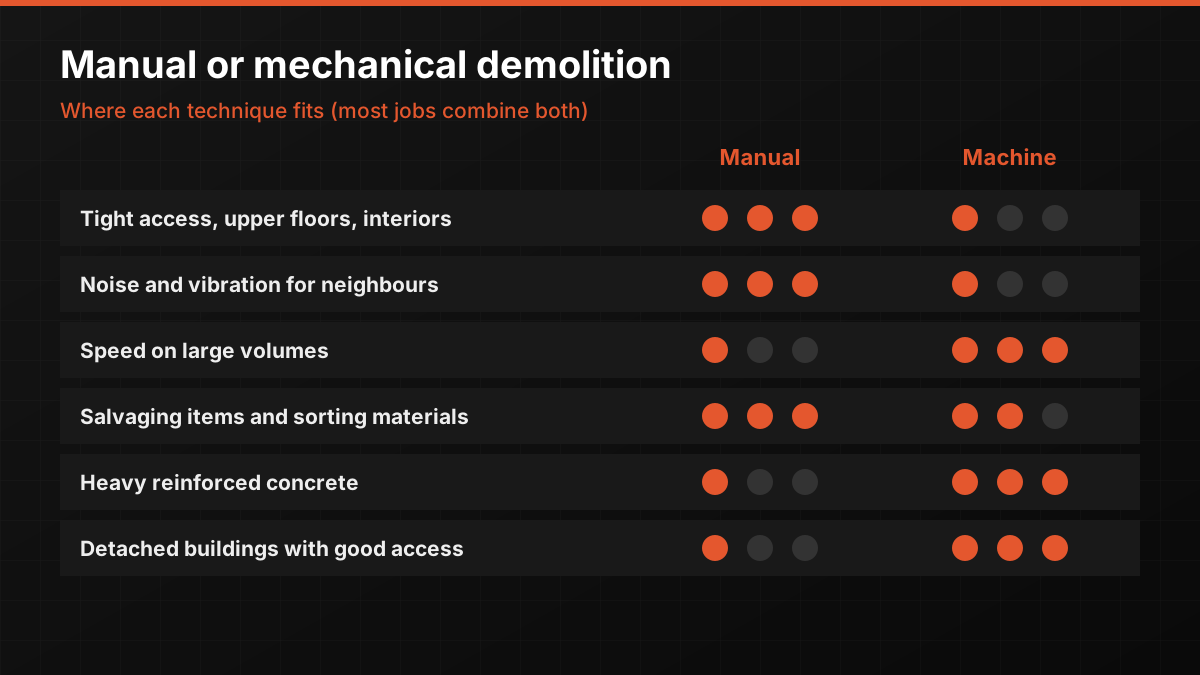
The trouble starts when the same approach is applied to something larger. A sledgehammer on a thick slab is exhausting, slow and hard on the body, and a reinforced slab will defeat hand tools almost entirely. If the slab is thicker than a hand-held breaker can handle comfortably, or if there is mesh or rebar inside, a machine is the safer and faster option. For the comparison between the two approaches in general, see our pillar site's demolition and debris removal page.
The worst ways to deal with a slab
Some methods appear quick or cheap and cause problems later:
- Burying the concrete on the plot. Broken slab pushed into a hole or covered with soil is still demolition waste. It creates unstable ground and problems for whoever builds there next.
- Mixing concrete with soil. Lifting slab and topsoil together in one bucket produces a mixed material that neither recycles well nor makes good fill.
- Breaking without checking services. Water pipes, drains, cables and old tanks often run under slabs. Breaking blindly can damage them or reveal them in the worst way.
- Ignoring the rebar. Leaving tangled reinforcement in the rubble makes loading dangerous and the concrete harder to recycle.
- Breaking a suspended slab like a ground slab. A slab over a basement or void is structural; removing it is a demolition with its own sequence, not a floor removal.
What to expect after the slab is gone
Once the concrete is removed, the ground underneath is exposed. Depending on the slab it may be compacted fill, a gravel layer, old soil or the remains of an earlier floor. The plot is left clear of rubble, and a basic levelling after the demolition can be part of the job. If the next step is a garden, a pool, landscaping or groundworks, our sister site on groundworks and levelling covers that side.
The concrete, the steel and any soil are delivered to authorised facilities as separate fractions, and you receive the delivery receipts. If the slab is part of a larger industrial job, it is usually removed after the building above it, as described in how we run a machine demolition.
Choosing the method: a summary
| Slab | Best method | Avoid |
|---|---|---|
| Small, thin, unreinforced patio or path | Electric breaker and hand tools, rubble bags | Bringing a large machine for a few square metres |
| Driveway or yard with mesh | Compact or mid-size excavator with breaker | Sledgehammer only |
| Industrial floor, heavy reinforcement | Excavator with breaker or crusher jaws, rebar separated | Breaking without a loading and sorting plan |
| Partial removal next to retained concrete | Saw cutting, then breaking inside the line | Breaking up to the edge without a cut |
| Suspended slab over a void | Planned structural demolition sequence | Treating it like a ground slab |
Every case can be discussed with photos before a site visit; our machine demolition page explains the machines involved.
Sources
Frequently asked questions
What is the fastest way to remove a large concrete slab?
An excavator with a hydraulic breaker or crusher jaws, with the excavator loading the broken concrete as it goes. For large or reinforced slabs nothing else comes close.
Can I remove a concrete patio myself?
A small, thin patio can be removed with an electric breaker and hand tools. Thicker or reinforced slabs are much safer and faster with a machine.
How do you know if a slab is reinforced?
We check edges, cracks and broken areas for mesh or bars. Industrial floors and driveways are usually reinforced; thin garden paths often are not.
Why cut a slab with a saw instead of breaking it?
Saw cutting leaves a clean edge and protects the concrete that stays. It is the right method for partial removals next to walls or retained floors.
Can broken concrete be buried on the plot?
No. It remains demolition waste and creates unstable ground. It must be taken to an authorised facility or recycled properly.
What happens to the steel in the slab?
The rebar or mesh is separated as the concrete is broken and is delivered as a metal fraction to an authorised facility.
Is removing a concrete slab noisy?
Breaking concrete is noisy and produces vibration. Work is done within permitted hours, and dust is controlled with water.
Do I need a permit to remove a slab?
It depends on the job and the town hall. A slab as part of a demolition falls under the demolition procedure; your técnico or the town hall confirms what applies.
Will removing the slab damage my garden?
Machine access needs a route and a working area. The route is planned in advance and protected where needed, but some disturbance to the surface along it is normal.
What is under a concrete slab usually?
Typically compacted fill, a gravel layer or old soil, and sometimes pipes or the remains of an older floor. That is why services are checked before breaking.
Can the concrete be recycled?
Yes. Clean concrete is a recyclable mineral fraction; it goes to an authorised facility or, on large jobs, can be crushed on site.